
The #1 Bird We Treat — and the Simple Thing You Can Do to Help
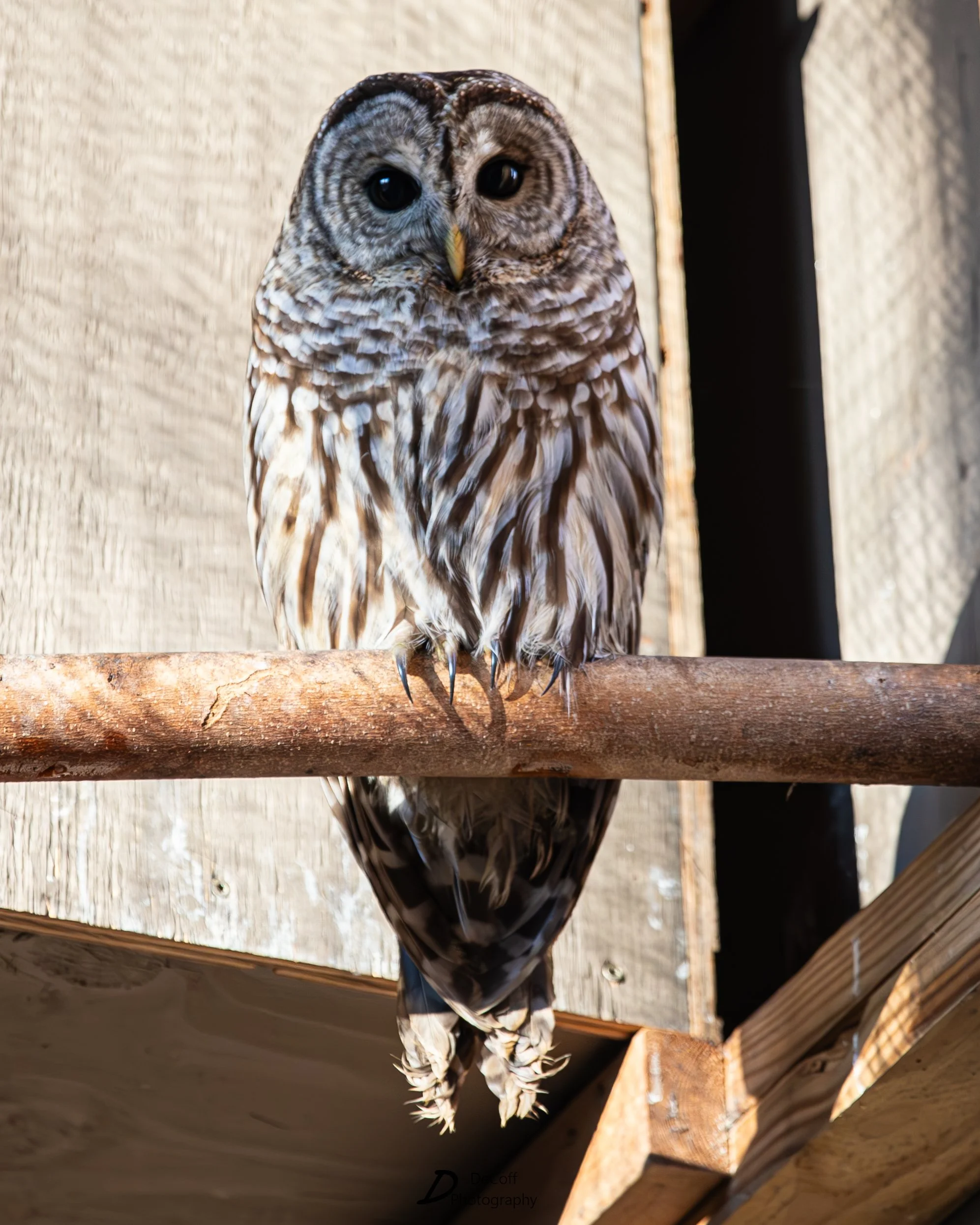
It's only March, and we've already admitted over 30 barred owls into our care this year.
That number might surprise you, but it's a pattern we know well. Last year, we treated 230 barred owls — making them the single most frequent species that comes through our doors. And the reason is almost always the same: they were struck by a car.
We want to tell you a little about these remarkable birds, why this keeps happening, and — most importantly — three simple things you can do to help.
Meet the Barred Owl
If you've ever been in the Maine woods at dusk and heard a deep, resonant call that sounds like "Who cooks for you?" — you've met a barred owl, even if you never saw it.
Barred owls are one of the most common and widely distributed owl species in Maine. They mate for life and prefer to call mature forest home, rarely venturing far from where they hatched. They nest in tree hollows, raise their young in the same familiar territory year after year. Babies can stick around the nest for up to six months, while adult owls can grow to be an impressive 20 inches tall.
They're also extraordinarily patient hunters. A barred owl will sit motionless on a low perch, scanning and listening with incredible precision, waiting for the faintest rustle of a mouse or vole below. When it pinpoints its meal, it drops from the perch in a silent, decisive swoop.
That hunting strategy is elegant in the forest. On a roadside, it's dangerous.
Why Roads Are So Deadly
Roadsides are open spaces — exactly the kind of clear ground where a barred owl can easily spot small prey moving through the grass. A mouse darting along the shoulder of a road looks like an easy meal. The owl swoops low from its perch, focused entirely on the hunt, and never sees the car coming.
It happens in an instant. And it happens hundreds of times a year across Maine.
The owls that survive the initial impact and make it to Avian Haven face a difficult road to recovery. Many arrive with head trauma, broken wings, or internal injuries. Our team works to stabilize them, but the truth is that prevention is always better than treatment.
That's where you come in.
Three Things You Can Do to Protect Barred Owls
Slow down at dawn and dusk. Owls are most active during the low-light hours of early morning and evening — the same times when they're hardest for drivers to see. Reducing your speed during these hours, especially on rural and wooded roads, gives both you and the owl more time to react.
Don't toss food from your car. An apple core or wrapper thrown from a window might seem harmless, but discarded food attracts mice and other small animals to the roadside. That, in turn, attracts hunting owls into the path of traffic. Keeping food waste in your car until you can dispose of it properly is one of the easiest things you can do to help.
If you hit an owl, call us. Pull over safely, locate the bird, and call Avian Haven at 207.382.6761. We're open from 9 a.m. to 5 p.m., 365 days a year. Our team will walk you through exactly what to do next to give that owl the best possible chance of survival. Don't assume the bird is beyond help — many of the owls we release back into the wild arrived in critical condition.
Every Owl Matters
Thirty barred owls in ten weeks. Each one is a life we're fighting for. Your support — whether it's slowing down on a dark road, keeping our number in your phone, or making a gift to help cover the cost of care — makes a real difference for these birds.
