
How We Work With Threatened Species: Blackpoll Warbler
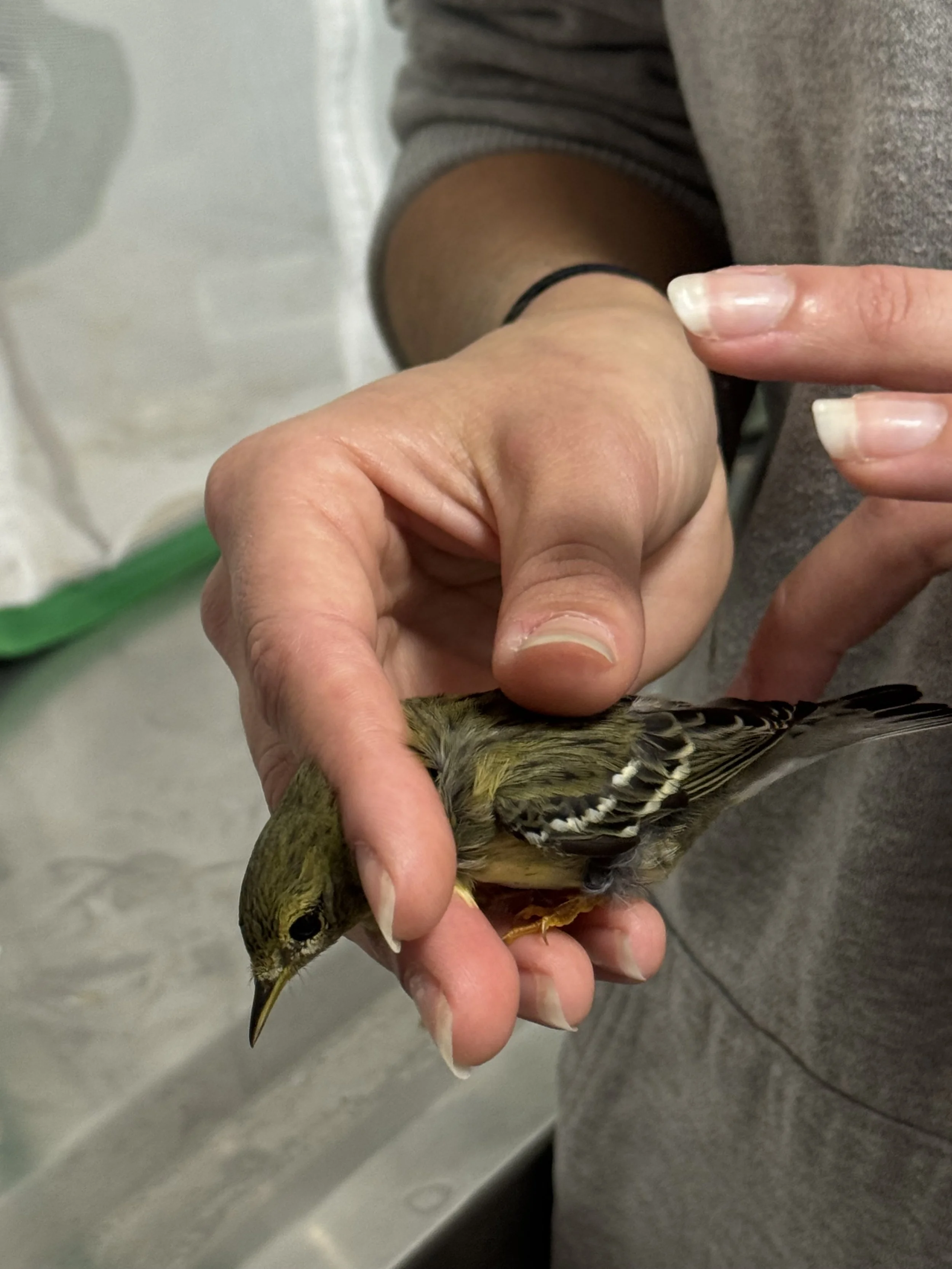
Last week, a small black-and-white streaked songbird was found on the sidewalk outside 300 Fore Street in Portland, stunned after colliding with a window. It was a Blackpoll Warbler, a bird that weighs about as much as two quarters and was likely beginning one of the most extraordinary journeys in the animal kingdom.
When Senior Rehabilitation Technician Athena Furr examined the warbler during triage, she noticed something striking: its flight muscles were lithe, smooth, and full, as if the bird had been training for this exact moment. In a sense, it had. Every fall, blackpolls spend weeks feeding heavily to build up the fuel and muscle they need for migration. This bird was ready to go.
The marathoner of the warbler world
You may have heard that the Blackpoll Warbler is the long-distance champion among warblers, and it's true. Blackpolls make the longest migration of any North American wood warbler. Some birds that breed in Alaska travel more than 5,000 miles to reach their wintering grounds in northern South America.
What makes them truly remarkable is how they get there. Many blackpolls leave the coast of New England and Atlantic Canada and fly nonstop over the open ocean to the Caribbean and South America, a journey of roughly 1,500 to 1,700 miles that takes up to three days without a single rest. To prepare, they can nearly double their body weight in fat before departure. For a bird this size, it is one of the most demanding feats of endurance in nature.
In spring, males are easy to recognize by their crisp black cap (the "poll" in their name is an old word for head) and bright white cheeks. In fall, both males and females turn a subtle olive-yellow with faint streaks, making them one of the classic "confusing fall warblers" that keep birders on their toes. Their song is so high-pitched that many people can't hear it at all.
Where blackpolls breed, and why they're in trouble
Blackpolls breed in cool spruce and fir forests across Alaska and Canada. Here in the Northeast, they nest mainly in high-elevation spruce-fir forests, including on Mount Katahdin, along with some coastal spruce forests and islands Downeast.
The Blackpoll Warbler is listed as a threatened species in Maine, and its population has declined dramatically across North America in recent decades, one of the steepest drops of any songbird. Several pressures add up. Climate change threatens the cool, high-elevation forests they depend on for nesting. Their long migrations leave little margin for error, so storms, habitat loss along the way, and changes on their wintering grounds all take a toll. Window collisions, like the one that brought patient 26-2255 to us, kill many warblers during migration, especially in brightly lit urban areas.
Because the Blackpoll is a threatened species, our team notifies the state after triage, sharing details about the bird and the circumstances of its injury. And we stay in touch throughout the rehabilitation process. This data helps wildlife officials better understand what's happening to at-risk species on the ground.
Racing the calendar
The good news: Patient 26-2255 has no broken bones. The warbler has a soft tissue injury to its left shoulder, which is causing its wing to droop. It is currently on cage rest and receiving periodic physical therapy to help it regain strength and range of motion.
For migratory birds, timing matters. When a migrant isn't too badly injured, we prioritize getting it outdoors as soon as it's safe, giving it the nutrition it needs to rebuild its reserves, and releasing it as quickly as we responsibly can so it still has a chance to join its migration. Patient 26-2255 is on track to move into an outdoor flight enclosure within the next week or so, where it can test its wing and build back its strength.
How you can help birds this fall
Millions of birds are moving through Maine right now. A few simple steps can help them make it safely:
🐤 Break up reflections on your windows with decals, screens, or exterior tape spaced a few inches apart.
🐤 Turn off unnecessary outdoor and indoor lights at night during migration.
🐤 If you find a bird that has hit a window, bring it to a rehabilitator, even if it seems to recover. Injuries aren't always visible.
🐤 For bird emergencies, call our hotline at (207) 382-6761 (9am–5pm daily). Our volunteers across the state are ready to bring birds to us.
Help us get Patient 26-2255 back in the sky
Every bird we take in receives expert care, specialized food, medication, and the time it needs to heal, and every one of those things depends on support from people like you. A gift today helps us give this tiny traveler, and the thousands of other birds we care for each year, a second chance at flight.
