
The Hardest Bird to Heal: Caring for Maine's Loons
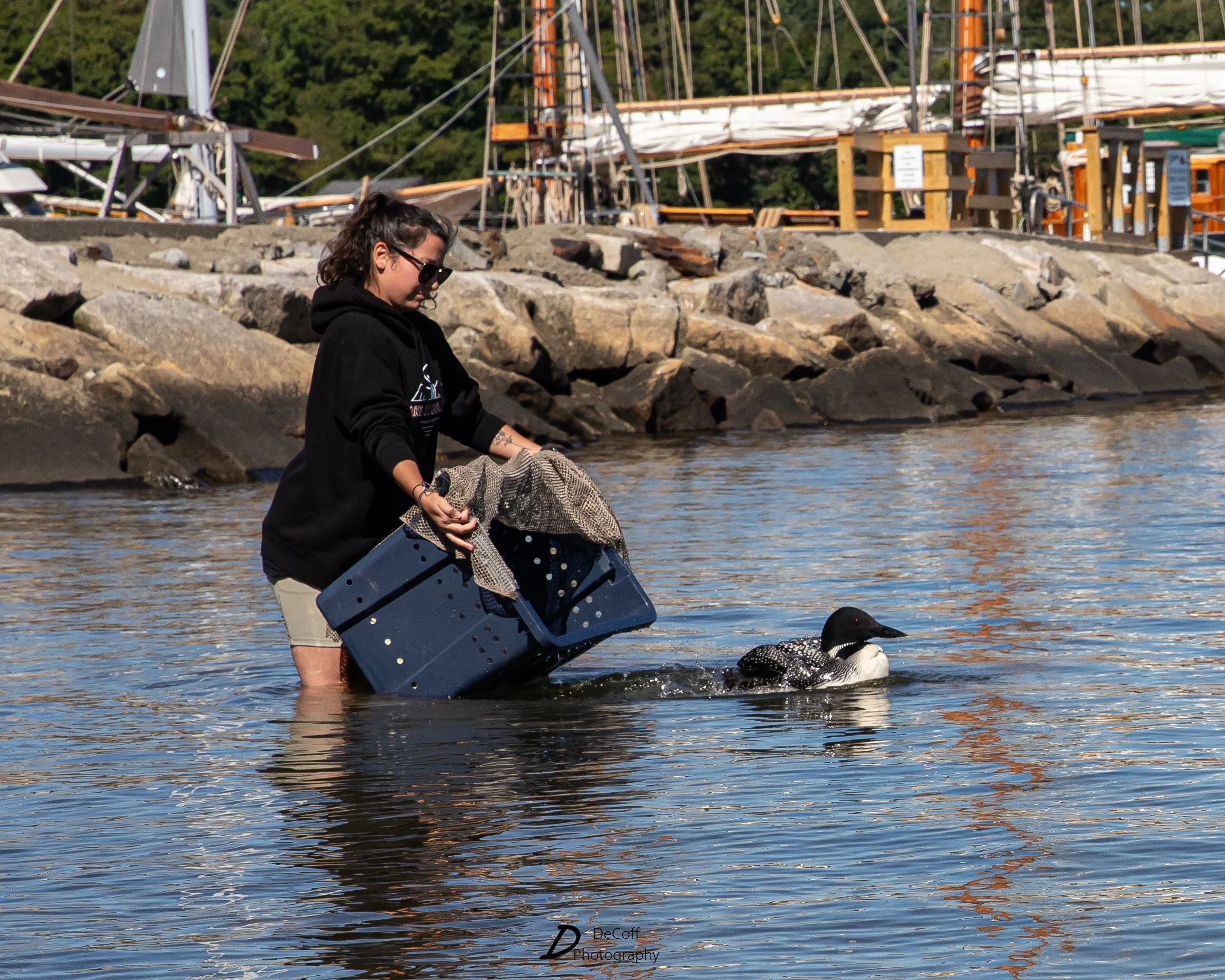
Maine is home to more breeding Common Loons than any state in the lower 48 except Minnesota, roughly 5,000 to 6,000 birds. So far this year, Avian Haven has taken in 15 of them.
Every one of those loons arrived needing more than most of our patients. That's because loons are among the most difficult birds in the world to rehabilitate.
"There's nobody in the world at this point who's good at loon rehabilitation," says Dr. Mark Pokras, a wildlife veterinarian who spent more than 30 years on the faculty at Tufts University and has advised Avian Haven since its early days. That's not a criticism of the people doing this work. It's a reflection of the bird itself, and of how much science still has to learn about it.
A bird built for water, and only water
Loons are made for life on lakes and the ocean. Their legs sit so far back on their bodies that they can barely walk, and they can't take off from land. A loon that lands on a wet road, mistaking it for water, is stranded.
That same design makes care in a clinic hard. "You can't keep a loon alive and healthy out of the water. Period," Dr. Pokras says. Out of the water, loons quickly develop painful sores on their breastbone, become stressed, and often stop eating.
The water itself has to be nearly perfect. A loon stays dry and warm because its feathers repel water. Even a thin film of fish oil or debris on the surface can break that seal. Dr. Pokras calls it "the top millimeter": the narrow layer of water that touches the feathers must be kept pristine.
When waterproofing fails, a downward spiral begins. A soggy loon leaves the water, gets sores, stops eating, loses weight and grows weaker. Once it starts, it is very hard to reverse.
The invisible threat: stress
The other great danger is one you can't see. Like people, birds under stress produce hormones that weaken the immune system. Loons appear to be especially sensitive to this.
In captivity, the most common result is a fungal respiratory infection called aspergillosis. There's no reliable early warning. By the time symptoms appear, it's usually too late to treat. "It's a prevention game," Dr. Pokras says, "and nobody's figured that out yet."
This is why you've never seen a loon at a zoo. According to Dr. Pokras, no one has ever kept a loon alive in captivity for an extended time.
How we give loons their best chance
The world's most experienced loon caregivers agree on two keys to success: water quality and stress reduction.
Avian Haven's loon pools were built with Dr. Pokras's guidance, and he calls them "state of the art" for loon rehabilitation. Systems in each pool keep the water's surface clean, protecting that all-important top millimeter.
To keep stress low, we use natural light, keep voices low, and minimally handle the loons in care.
Speed matters too. Dr. Pokras shares a favorite line from fellow veterinarian Dr. Erica Miller: the secret to loon rehabilitation is "getting them out the door as fast as you can." Every extra day in care raises the risk.
Sometimes less is more
That lesson came home to Dr. Pokras on a remote lake in Washington State. He and two local loon monitors found a loon tangled in fishing line, with a deep wound on its leg. The nearest rehab center with a loon pool was nearly six hours away.
With only a sanitized pocketknife, Dr. Pokras carefully cut the line free. Then the team made a hard choice: rather than put the loon through a long drive and a stay in captivity, they let it go.
The next year, that same loon was nesting and raising chicks. Monitors followed it for three more years.
"Sometimes stress reduction is much more important than sophisticated medical care," Dr. Pokras says. For loons, the best care often means a careful exam, treating only what truly needs treating and getting them home quickly.
Every loon teaches us something
Even when a loon can't be saved, its story adds to what we know. Our team works with Dr. Pokras to learn from every case, and shares what we learn with loon experts across North America. Each loon we care for helps move the science forward for the ones that come next.
If you see a loon on land, on a road or stranded somewhere it can't take off, call our hotline at (207) 382-6761 (9 am to 5 pm, every day). Keep your distance; loons have sharp beaks. We have volunteers across the state ready to bring birds to us.
Pack out your fishing line. Discarded line and tackle injure loons every year.
Give a loon a second chance. Caring for a single loon takes specialized pools, constant attention, and several pounds of fresh fish every day. Your gift makes that possible.
Thank you for caring about the birds that make Maine's lakes feel like home.
