
This kills 1 BILLION birds a year
Every year, up to 1 billion birds die after colliding with windows in the United States — making glass one of the single greatest threats to wild birds across the country. From the towering glass facades of city skyscrapers to the kitchen window above your sink, no pane of glass is without risk. At Avian Haven, we see the consequences of this crisis firsthand, and we want to share what you can do to help.
Why Glass Is So Dangerous
Birds simply cannot recognize glass the way we do. To a bird in flight, glass presents two deadly illusions:
Reflective glass mirrors the sky and surrounding vegetation, tricking birds into believing they are flying toward open habitat.
Transparent glass appears invisible — especially when a room is lit from inside — making a window look like a clear path through to the other side.
The result is a high-speed collision that can kill a bird instantly, leave it gravely injured, or stun it temporarily. Yet if you see a bird fly away after a strike, it may still be in serious trouble. Birds that appear mobile after a collision can be suffering from internal injuries, concussions, or trauma that — left untreated — will prove fatal. When in doubt, it is always worth making a call.
What You Can Do Right Now
The good news is that bird-window collisions are preventable, and there are simple, effective steps you can take at home and at work:
Apply window decals or films — Products like Feather Friendly dots break up the reflective and transparent surface, making glass visible to birds. Patterns should be spaced no more than 2 inches apart horizontally and 4 inches vertically to be effective.
Install external screens or netting — Physical barriers that cover the outside of windows are among the most reliable solutions available.
Reposition feeders — Place bird feeders either within 3 feet of a window (close enough that a bird cannot build up dangerous speed) or at least 30 feet away (far enough that birds approach cautiously).
Add awnings or exterior shading — Reducing the reflectivity of glass from the outside significantly lowers collision risk.
Turn off interior lights — Especially during spring and fall migration, reducing indoor lighting at night helps prevent birds from being drawn toward lit windows. Used in combination with the solutions above, this can make a real difference.
Maine Is Leading the Way
Here in Maine, advocates are making meaningful progress. BirdSafe Maine — a statewide collaboration dedicated to raising awareness and driving solutions through research, policy, design, and education — helped secure the passage of P.L. 2023 Chapter 221 (L.D. 670): An Act to Protect Birds and Wildlife in the Construction and Maintenance of Public Buildings. This law requires Maine's Bureau of General Services to develop guidelines for integrating bird-safe principles into the design and maintenance of public buildings statewide.
BirdSafe Maine is also working directly with architects and building designers to incorporate bird-safe glass and other protective measures into new construction — and to retrofit existing buildings that pose a risk. Their comprehensive building guidelines are available here:
👉 BirdSafe Maine Building Guidelines
Found a Bird After a Window Strike? Here's What to Do.
If you find a bird that has hit a window, please don't assume it will be fine on its own. Here's how to help:
Gently contain the bird in a small cardboard box with air holes, or a paper bag — somewhere dark, quiet, and secure.
Do not offer food or water.
Call Avian Haven at 207.382.6761. We are open 9 a.m. to 5 p.m., 365 days a year. One of our rehabilitation technicians will walk you through the next steps and let you know whether the bird needs to come in for care.
Every bird you help reach us is a bird with a fighting chance. Your swift action in those first moments can make all the difference.
One Owl's Story
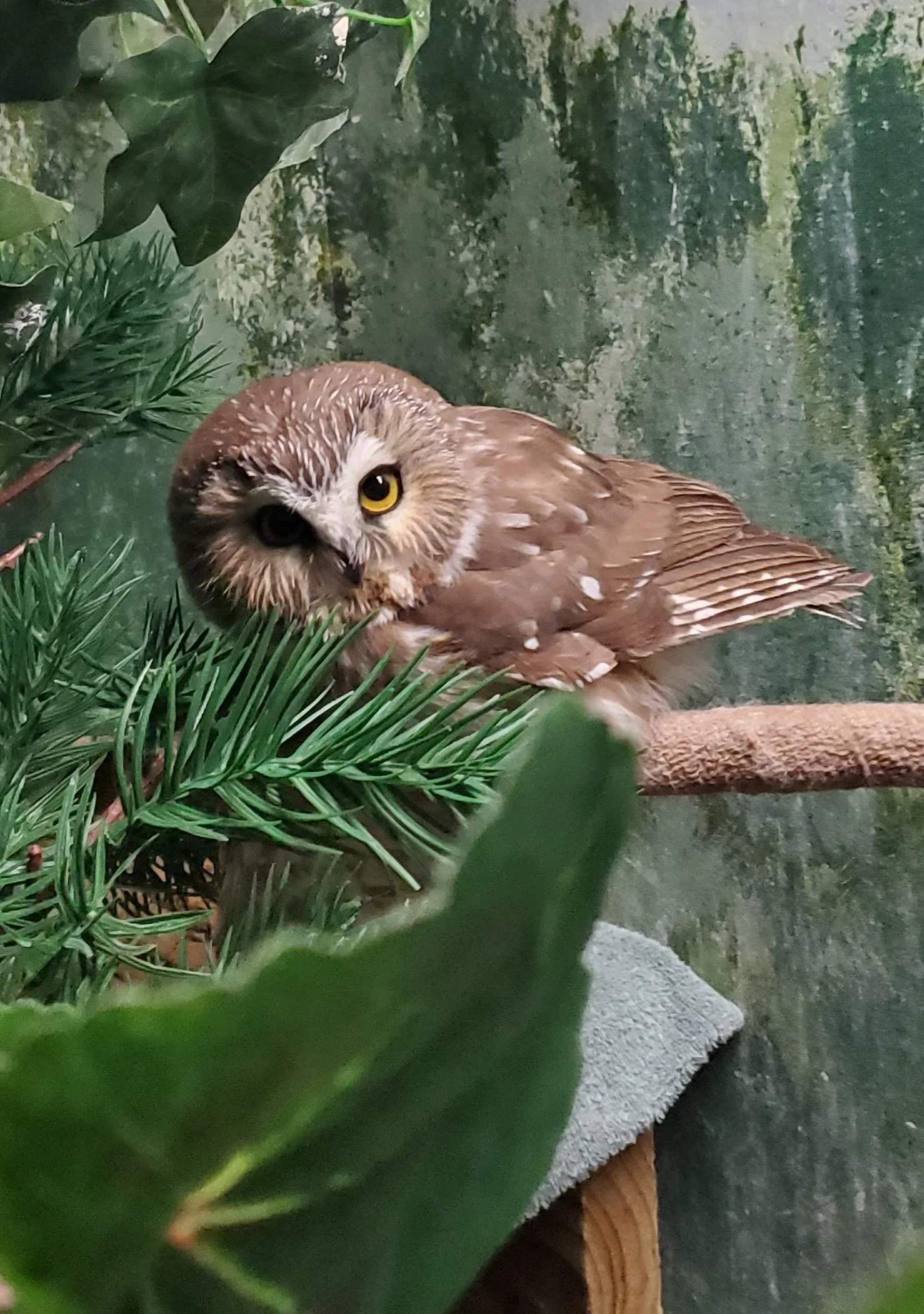
About a month ago, a small Northern Saw-whet Owl arrived at Avian Haven after striking a window. He was lucky to have been found at all — as we described above, birds that seem to survive a collision often carry injuries that aren't visible to the untrained eye. In his case, the impact had caused damage to his eyes and left his brain in need of time and quiet to heal.
Saw-whet Owls are remarkable little birds — among the smallest owls in North America, and fierce hunters despite their size. But in those early days in our care, this one needed patience more than anything else. Our rehabilitation technicians provided supportive care, monitored his vision closely, and gave his nervous system the rest it required to recover.
We are glad to share that he is doing well. His progress over the past month has been encouraging, and we are hopeful that he will be ready for release soon — back to the forests and fields where he belongs.
His story is not unusual. Window strikes bring birds like him to us throughout the year. What is unusual is that he was found, and that someone took the time to call.
Support the Birds That Need Us Most
Window strikes bring injured birds to our door throughout the year — and each one requires skilled hands, proper medical care, and time before it is ready to return to the wild. If this work moves you, please consider making a donation to Avian Haven. Your generosity directly funds the care of birds like the ones described in this newsletter — and helps us keep our doors open every single day of the year.
