
The Journey of Our Peregrine Falcon Patient
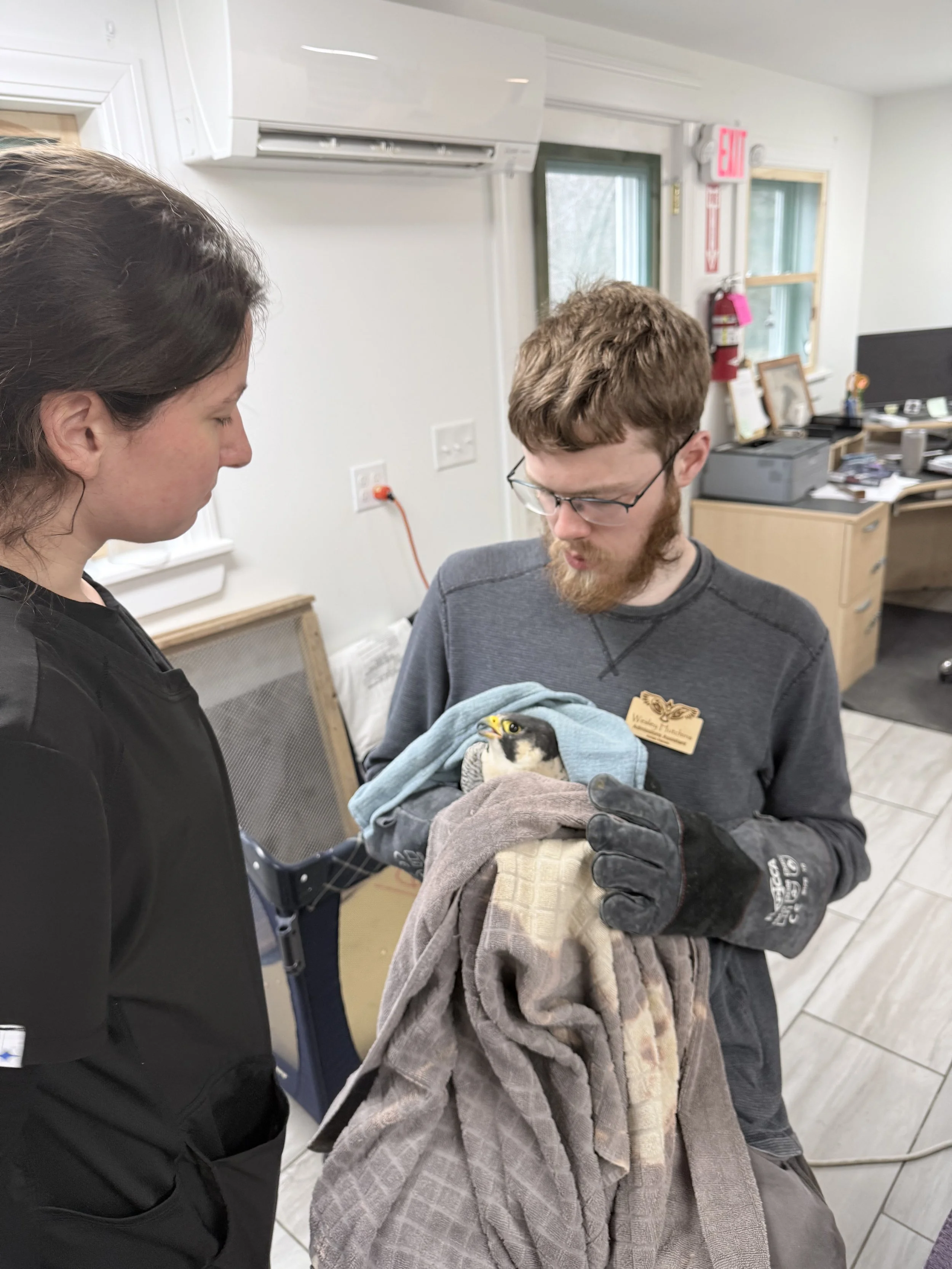
There is a particular kind of awe that comes with standing near a peregrine falcon. Even at rest, the bird radiates velocity — the coiled power of a creature built to cut through the sky at speeds no other animal on Earth can match. When a peregrine arrives injured, the weight of that feels significant. When one leaves healthy, it feels like a small miracle.
Earlier this year, we received a male peregrine falcon with an open fracture of the wing. After carefully cleaning the wound and making sure the exposed wound maintained a moist setting, we transferred the critical condition bird to our Consulting Veterinarian, Dr. Avery Berkowitz’s center, Maine Wildlife Rehabilitation, to assess the patient for surgery. He had sustained multiple fractures to the carpometacarpus — the small, complex bones at the end of the wing where soft tissue coverage is thin and the stakes of healing are high. The wound was open, with tendons exposed. It required careful, sustained attention. Surgery wasn't advised because this is an area with less soft tissue coverage than other parts of the wing and there was an open portion with tendon exposure. The bird had a tremendous amount of care with our partners at Maine Wildlife Rehabilitation. The fractures stabilized. The wound closed. The tendon exposure healed. He was then transferred back to us.
Peregrine falcons don't glide. They swoop. In a hunting dive, they can exceed 200 miles per hour, making them the fastest animals on the planet. They pursue prey on the wing, with the kind of aerial agility that requires every system to be working at full capacity. Rehabilitation isn't just about healing the injury — it's about restoring the whole bird. That means flight reconditioning: building strength, coordination, and confidence back up systematically, in a space large enough to matter.
Our “flyway” enclosure — which allows raptors to fly in a circular formation, a revolution for the industry and now considered a standard of care — gave him room to begin finding himself again as a flier. And he used it.
But peregrine falcons are also acutely sensitive birds. They stress easily, and stress itself can become a medical problem. As his conditioning progressed, it became clear he needed more space than even our flyway could offer. Because the injury was so significant, it was important to see if this bird has the capacity to get to high speed and have the agility necessary to engage as a peregrine would in the wild.
That's where this case took a turn we'd never taken before.
Working with Maine Inland Fisheries and Wildlife — whose team has been following this bird's progress closely, a reflection of just how rare and significant peregrine falcons are in our state (there are only about 30 breeding pairs in Maine) — we arranged a handoff to a licensed falconer for continued conditioning. This kind of partnership is uncommon in wildlife rehabilitation. It requires trust, coordination, and a shared commitment to the bird's welfare above all else.
“We are thrilled to partner with the state, our consulting vet, and to work with a falconer in our community to do what is best for this bird,” said Barbara Haney, Executive Director at Avian Haven. “And this case shows just how important rehabilitation is for the future of all birds.”
Of course this peregrine falcon isn’t out of the woods yet and still has a long road ahead. But he is flying, and that means everything. We hope that this story illustrates how complex the work of rehabilitating an endangered species (or any bird for that matter!) is. Please send good thoughts in the direction of our falcon patient for a continued recovery.
Stories like this one are what make Avian Haven possible — but they are never simple, or cheap, or quick. If you've been moved by this peregrine's journey, consider making a gift in his honor at avianhaven.org/donate. Every contribution helps us say yes to the next bird that needs us.
