
Over 100 Baby Birds — And Not One of Them Can Know We're Here
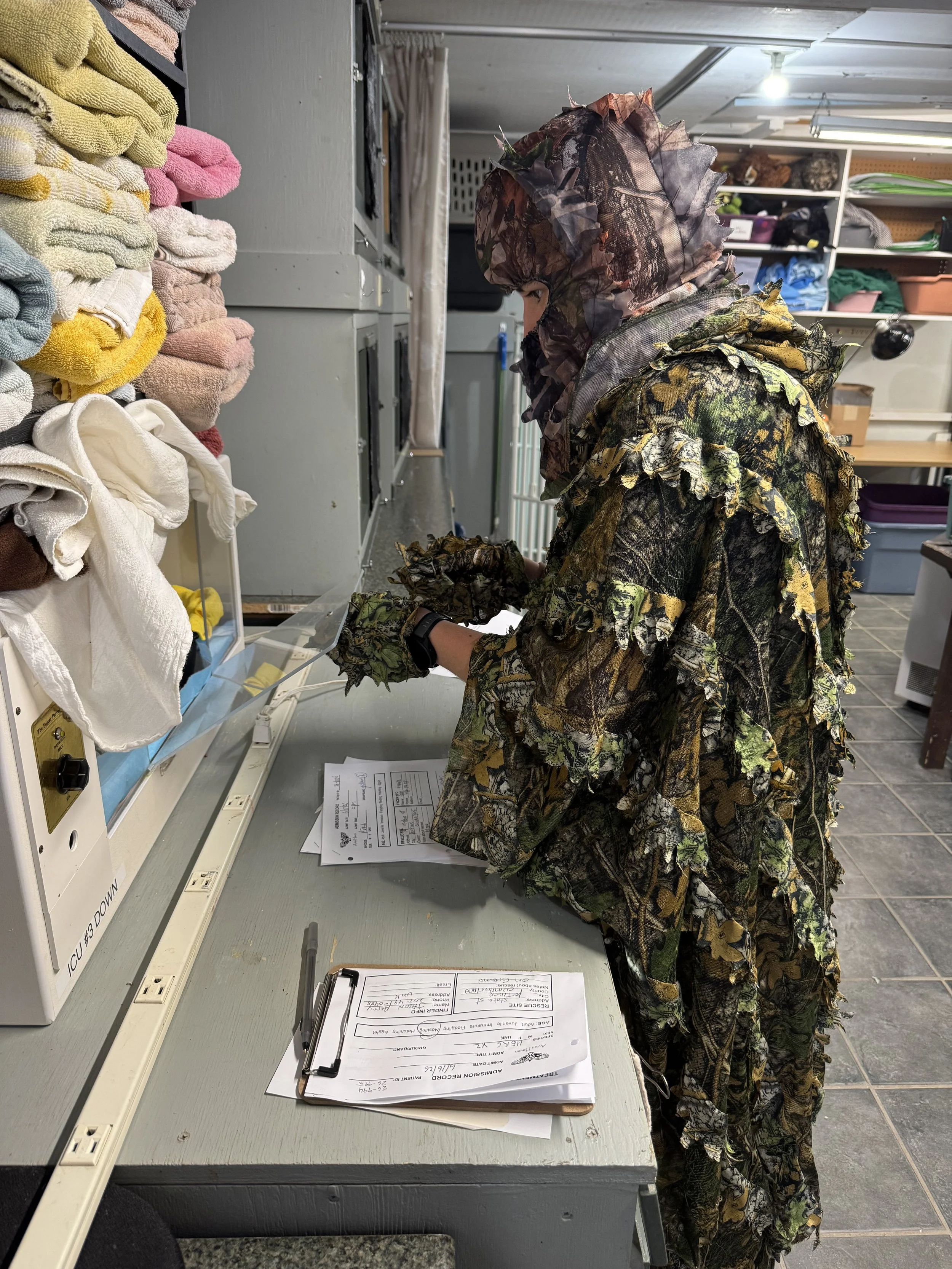
Right now, Avian Haven is caring for more than 100 baby birds. Crow fledgelings, gull chicks, and goslings. Owlets and eaglets. Ducklings and Woodcocks tinier than a fist. Each one arrived injured or orphaned — and each one carries a hidden vulnerability that shapes every decision we make about how we feed them, house them, and interact with them.
That vulnerability is called imprinting, and preventing it is one of the most delicate — and most important — things we do.
What Is Imprinting?
Imprinting is a hard-wired survival mechanism: in the earliest days and weeks of life, a bird learns who it is by observing who raises it. In the wild, that's a parent of the same species. In a rehabilitation setting, without careful intervention, it can become a human.
An imprinted bird doesn't simply grow up tame. It grows up with a fundamentally altered sense of identity. It may not recognize its own species as kin. It may not learn the social behaviors, vocalizations, and survival instincts it needs to survive in the wild. For many species, this is a death sentence.
Crows are a sobering example. Crows are intensely social animals — they live and survive within tight-knit family groups, rely on communal alarm calls, and learn from one another throughout their lives. An imprinted crow will fail to integrate with other crows. Instead, it will seek out human contact — approaching people, lingering near homes, losing the wariness that keeps wild birds safe. It cannot go back. The window for healthy socialization closes early, and it doesn't reopen.
Herring gulls also present a particular challenge. Chicks are loud, demanding, and bond quickly — and an imprinted gull grows into a bird that associates humans with food and safety. That's a bird that will approach people on beaches and docks, that loses its wariness, and that often ends up harassed or harmed as a result.
Imprinted raptors — hawks, owls, eagles — may direct courtship behavior toward humans rather than their own kind, making them impossible to release. Geese are particularly susceptible: they bond to their caregivers almost immediately, and an imprinted goose will follow, trust, and seek out humans for the rest of its life.
What Imprinting Looks Like
Staff watch for specific behavioral cues: a bird that approaches humans rather than retreating, that vocalizes to get human attention, that shows no wariness around people. In some species, these signs are subtle and emerge gradually. In others — especially corvids and waterfowl — the window is short and the shift can happen quickly. That's why prevention begins from day one.
The Protocols That Protect Them
Our rehabilitation technicians use a range of tools and practices designed to ensure that our patients see, hear, and associate with their own kind — not with us.
When feeding vulnerable species, staff wear ghillie suits — full camouflage that breaks up the human silhouette and prevents birds from associating the source of food with a person. Stuffed birds serve as surrogate presences: a crow nestling is fed beside a stuffed crow; an owlet sees what an owl looks like long before it ever sees another live one. Audio recordings of species-specific calls play during care, reinforcing the sounds of their own kind. Whenever possible, same-species companions are introduced so birds can socialize, compete, and learn from one another naturally.
With our goslings, we add one more layer: when staff enter to clean or feed, they clap. Repeatedly. Purposefully. The goal is simple — geese should associate human presence with mild disruption, not comfort. That small habit, practiced every single day, can mean the difference between a goose that survives and one that doesn't.
Human interaction is kept to the minimum required for safe care. The birds don't need to know us. They need to know each other.
Why It Matters — And How You Help
This level of care takes time, training, and resources. The ghillie suits, the careful housing arrangements, the hours of behavioral monitoring — none of it happens without the support of people who believe wild birds belong in the wild.
If this work matters to you, consider making a gift today. Every contribution helps us give Maine's birds the one thing they need most: a genuine chance at a wild life.
