
A Law Written in Feathers: The Migratory Bird Treaty Act and Why It Matters
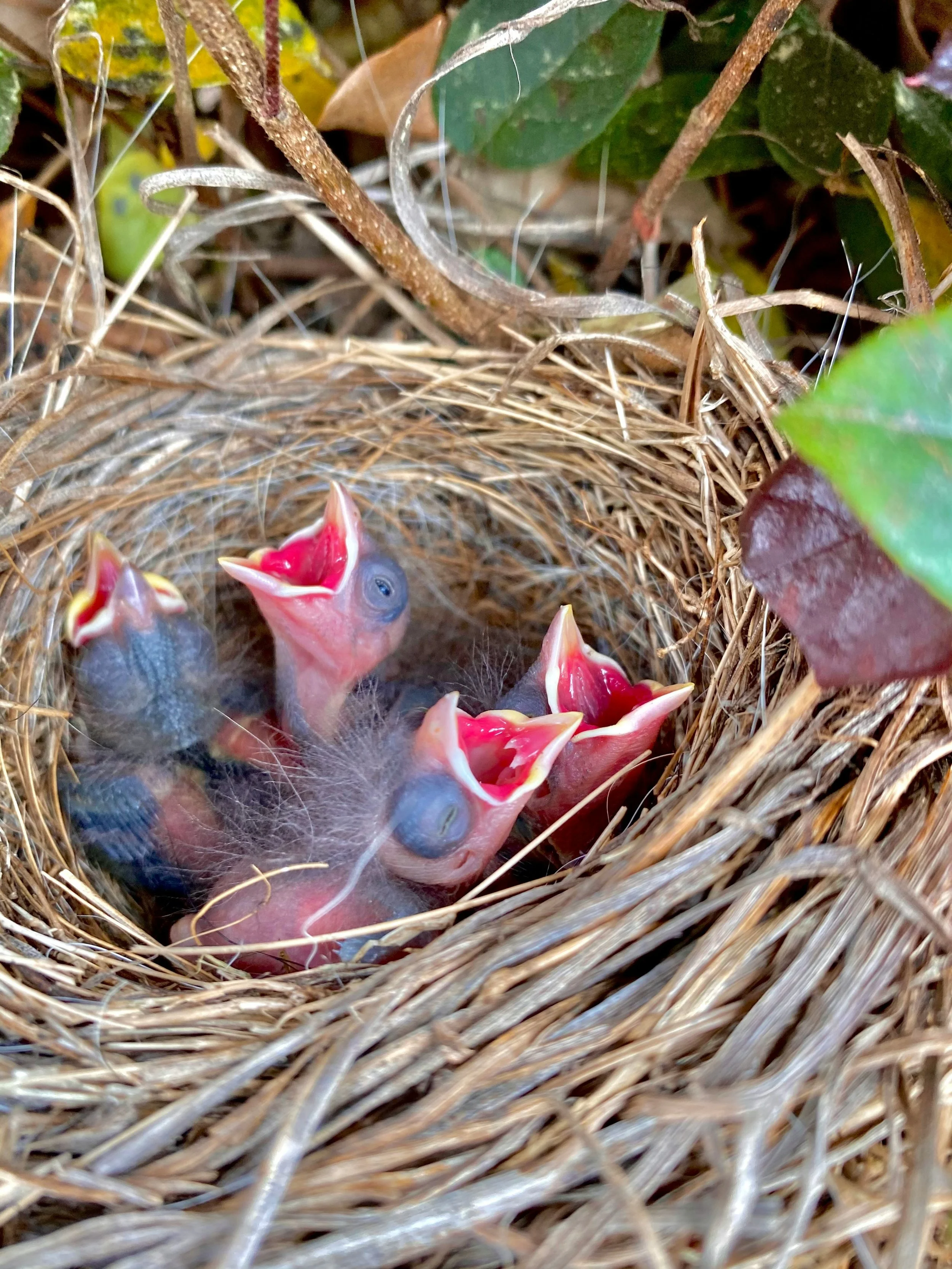
Every spring and summer, our phones ring with concerned callers who've discovered a nest tucked into a wreath, a gutter, a porch light, or a hedge — sometimes in the most inconvenient places imaginable. And every time, we share the same message: please leave it alone. That's not just our advice. It's the law.
The Migratory Bird Treaty Act of 1918 (MBTA) is one of the oldest and most important wildlife protection laws in the United States. Understanding it can help you protect the birds around your home — and help us do our work.
What is the Migratory Bird Treaty Act?
Enacted more than a century ago, the MBTA was born from a crisis: the widespread slaughter of wild birds for the millinery trade — feathers to adorn fashionable hats — had pushed many species toward extinction. Public outrage, combined with visionary advocacy, led to international treaties with Canada, Mexico, Japan, and Russia, and ultimately to federal legislation that gave those treaties teeth.
The MBTA makes it illegal for anyone — without a federal permit — to "pursue, hunt, take, capture, kill, possess, sell, purchase, barter, import, export, or transport" any migratory bird, or its eggs, feathers, or nest. That protection applies to living birds, dead birds, and even empty nests that may still be in use. Violators can face fines and criminal penalties.
Today, the MBTA protects more than 1,000 species of birds found in the United States.
Why Nests Cannot Be Removed — Even Empty Ones
This is one of the most misunderstood aspects of the law. Many people assume that once baby birds have fledged and flown, a nest can be removed without consequence. In most cases, that's true — but timing matters enormously, and removing a nest while eggs or young are present is a federal offense.
Nesting season in Maine runs roughly from April through August, with many species raising two or even three broods in a single summer. A nest that appears empty may be between clutches — and the parents may return within days.
The law is clear: if a nest contains eggs or chicks, or if a protected species is actively using it, it cannot be disturbed, moved, or destroyed without a federal permit. If you find a nest in an inconvenient location on your property, we encourage you to reach out to us — we're happy to help you think through your options.
The Gift of a Few Weeks
If a bird has chosen your porch, your roofline, or your garden hedge to raise its young, you've been given something quietly remarkable: a front-row seat to one of nature's most determined acts of survival.
Most songbird nests are active for just three to six weeks from egg-laying to fledging. Robins, for example, incubate their eggs for about two weeks, and their chicks fledge roughly two weeks after hatching. Barn Swallows take a little longer — closer to three weeks in the nest after hatching. Even the most "inconvenient" nest is, in the span of a summer, a brief houseguest.
While you're waiting, you may witness something worth watching: parents making dozens of feeding trips each hour, chicks growing visibly day by day, and eventually — often on a single morning that feels too soon — an empty nest.
We encourage you to lean into it. Note the species. Count the trips. Share the photos. And when the nest is quiet and the season has turned, you can remove it knowing you gave those birds their start.
Not every nest is easy to find, though. Bobolinks, Savannah Sparrows, Eastern Meadowlarks, and other grassland birds nest directly on the ground — tucked into hayfields and pastures, invisible until you're already upon them. For these species, the threat doesn't come from a curious neighbor or a misplaced wreath hook. It comes from a tractor.
Early haying is one of the leading causes of nest destruction for ground-nesting birds in Maine, and many of these species are already in serious decline. Bobolinks, whose extraordinary migration takes them all the way to South America and back each year, have lost more than 65 percent of their North American population since 1970. The meadows that once rang with their bubbling, otherworldly song are quieter now.
If you manage fields or pastures — or know someone who does — please consider waiting until after July 15th to hay. Most ground-nesting birds will have fledged by then. That single change can mean everything for the birds in your fields. You can also contact AgAllies, who will come out an assess your fields for ground nesters.
Why That Start is So Hard-Won
The world those fledglings fly into is not an easy one. Wild birds face a gauntlet of hazards that have grown more severe in recent decades — many of them the direct result of human activity.
Up to one billion birds die each year in the United States from collisions with windows and buildings. Outdoor cats — both owned and feral — kill an estimated billion birds annually, making them the single largest human-caused source of bird mortality in North America. Rodenticides move silently up the food chain, killing the raptors and owls that eat poisoned rodents. Habitat loss continues to shrink the places birds can find food, shelter, and safe nesting grounds. Climate change is shifting insect emergence and plant phenology in ways that increasingly misalign with the timing birds have evolved to depend on.
North America has lost nearly three billion birds — roughly 30 percent of the total population — since 1970. That is not a distant or abstract number. It is the silence where there used to be song.
Why Rehabilitation Matters
Against that backdrop, wildlife rehabilitation is not a footnote. It is a direct response.
Every bird that reaches Avian Haven is a bird that has already run a difficult race — injured by a window strike, poisoned by a rodenticide, orphaned too young, or grounded by illness. Our job is to meet them where they are: to provide the veterinary care, the species-appropriate nutrition, the quiet and safety they need to recover. And then to return them to the wild, where they belong.
We do this for ~3,000 birds a year, across more than 150 species, in all 16 Maine counties. We do it at no charge to the people who bring them to us. We do it because each bird represents not just an individual life, but a thread in an ecological fabric that, once lost, is very hard to restore.
When you support Avian Haven, you are not just helping one bird. You are helping hold the line.
Wild birds are protected by law — but they are sustained by community.
When you call us, deliver a bird to a transporter, or support our work with a gift, you become part of something that has been quietly unfolding for over a century: the collective effort to ensure that wild birds have a place in the world. Thank you for being part of it.
