
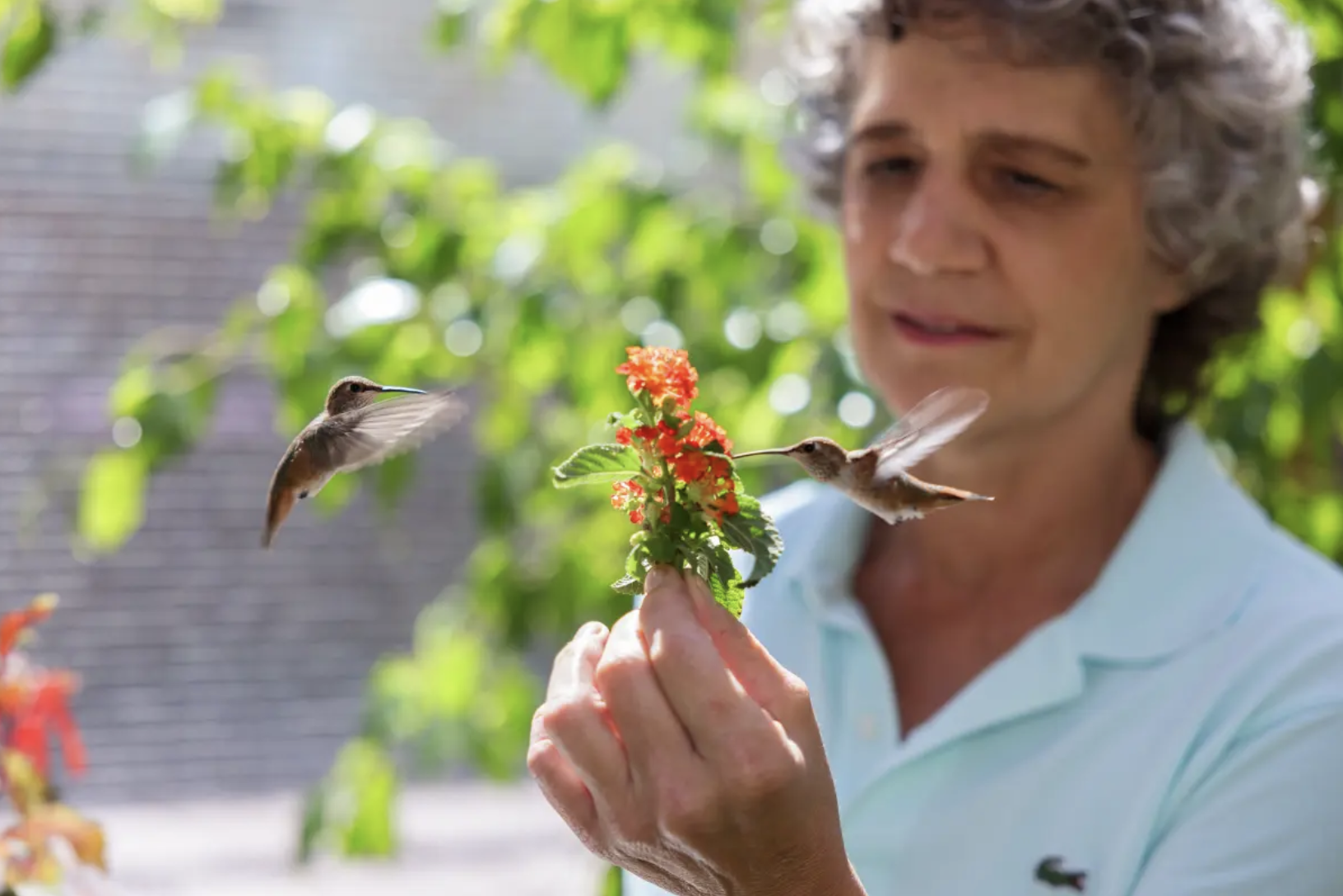
There's a moment near the end of Every Little Thing, the documentary from director Sally Aitken, when hummingbird rehabilitator Terry Masear says something that stopped us in our tracks:
"When you show love for something, and you don't have to, it's an act of greatness."
The film follows Terry through a season of caring for injured and orphaned hummingbirds in Los Angeles, and anyone who has worked in wildlife rehabilitation will recognize her world instantly: the ringing phone, the shoebox arriving at the door, the hours of hand-feeding, the hope, and sometimes the loss.
What moved us most is how much of Terry's work is about people. Callers reach her because they care, but in their care they sometimes do the wrong thing: keeping a bird too long, feeding it something harmful, or picking up a fledgling who didn't need rescuing. Terry meets them with patience, and she's protective of them too. She knows that not everyone is ready to hear that a bird didn't make it, and she chooses her words gently.
That tenderness extends to every bird in her care. She buries the ones who pass away with quiet ceremony. And when a recovered hummingbird lifts off for a flight out of its enclosure, she watches it go with the kind of attention that tells you each one mattered. It is a beautiful portrait of what this work asks of us, and what it gives back.
Meet Maine's Hummingbird: The Ruby-throated
While Terry cares for several western species, here in Maine we have just one: the Ruby-throated Hummingbird, the only hummingbird that nests in eastern North America.
They are astonishing. A Ruby-throat weighs about three grams, less than a penny. Its wings beat more than 50 times per second, and its heart can race over 1,000 beats per minute. Each fall, many fatten up to nearly double their weight and then fly roughly 500 miles nonstop across the Gulf of Mexico. To survive cold nights, they can drop into torpor, a state of deep rest that slows their body down to conserve energy.
44 Ruby-throats at Avian Haven This Year
This year, Avian Haven has taken in 44 Ruby-throated Hummingbirds. Some arrived exhausted from migration or from being caught inside a house with nothing left in reserve. Others struck windows, were caught by cats, or were orphaned nestlings no bigger than a bumblebee.
Hummingbirds are among the most demanding patients we treat. That incredible metabolism means they burn through energy fast, and they can slip into nutritional crisis quickly. They need to feed constantly, which means constant attention throughout the day from our team. And because sugar water alone can't sustain them (wild hummingbirds eat insects for protein), their diet in care has to be carefully balanced to help them rebuild strength.
Every one of those 44 birds received the kind of patient, painstaking care Terry shows on screen. It's the act of greatness she describes: love offered to a creature who can never repay it.
How You Can Help Hummingbirds
Now that the season is over and the Ruby-throated hummingbirds have all migrated, this is a great time to remove your feeder, clean it, and put it aside for next year. During the season, you can also:
🐤 Make windows visible. Apply decals, tape, or screens spaced no more than two inches apart on the outside of the glass. Any bird that strikes a window should be evaluated by a rehabilitator, even if it seems to recover.
🐤 Keep cats indoors. Even a quick swipe can be fatal for a bird this small.
🐤 Keep feeders clean. Use one part white sugar to four parts water, with no red dye or honey. Change nectar every two days, more often in hot weather.
🐤 Call before you intervene. Hummingbird mothers visit their nests briefly and infrequently, so a nest that looks abandoned often isn't. If you find a hummingbird in trouble, call our hotline at (207) 382-6761 (9am–5pm daily, for bird emergencies) and our volunteers across the state are ready to bring birds to us.
Help Us Care for Every Little Thing
A three-gram bird needs an enormous amount of care to make it back to the wild. Your gift helps provide the specialized diet, skilled hands, and constant attention that hummingbirds, and nearly 3,000 other birds each year, depend on.
Want to watch? Every Little Thing is available on Prime.
