
Why We Don't Name Our Birds
Every so often, we get a version of the same question.
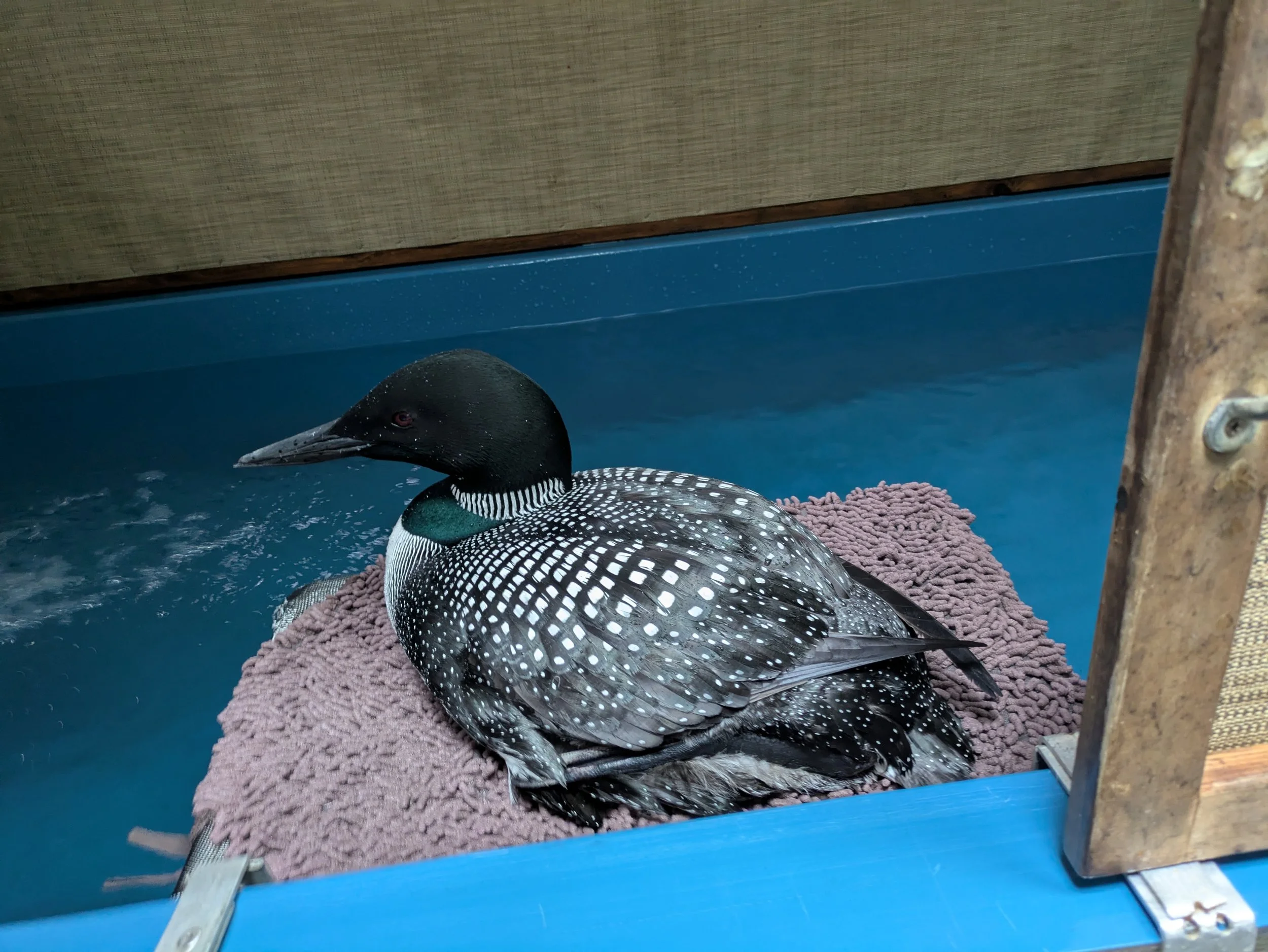
Someone has just brought us a bird — a stunned thrush found under a window, a young kestrel grounded in a parking lot, a loon tangled in fishing line — and as they hand it over, they ask: "Will you let me know how she does? I've been calling her Luna."
It's a tender impulse. The person has spent hours worrying about this animal. They've already formed a bond. Of course they want to follow her story.
We understand that completely. And we gently explain that at Avian Haven, we don't name our patients — and that this small practice is one of the most important things we do.
The Bird Doesn't Know Her Name
Naming is a human act. It changes us, not the bird. The moment we attach a name to a patient, something subtle shifts in how staff and volunteers interact with it — how close we allow ourselves to get, how we read her behavior, how we interpret distress as personality. "Luna seems grumpy today" is a very different observation than "this bird is showing heightened fear responses at feeding time." One invites affection. The other invites action.
Wildlife rehabilitation exists on a razor's edge. We care deeply about our patients, and we care for them with rigor. Those two things can pull in opposite directions, and we have to manage that tension every single day. Naming a bird is one small way the line between them blurs.
Our intake system reflects this: every patient receives a case number. Not because we're indifferent — but because precision protects them.
On the Question of Educational Birds
People sometimes ask why Avian Haven doesn't maintain a roster of "ambassador birds" — non-releasable animals who would live permanently in our care and appear at educational events, schools, or nature programs. Many wildlife organizations do this, and they do it with genuine good intentions. We respect that work.
But it's not our work — and here is why.
Birds that cannot be released are birds that have usually suffered significant trauma: permanent vision loss, a wing that cannot be fully restored, neurological damage from a collision. Keeping such a bird in permanent captivity means asking it to spend its life in a state its biology never prepared it for.
Research on this is sobering. Studies measuring corticosterone — the primary stress hormone in birds — consistently find that wild-caught raptors used in educational programs maintain elevated stress levels even after extended conditioning periods. Unlike birds raised from hatching in human care, a bird that grew up wild never loses its hardwired fear of predators — which, to that bird, includes us. The glove is not a perch. It is a threat that has simply become inescapable.
There are organizations with the specialized facilities, staff expertise, and welfare protocols to do this responsibly. We are not one of them — and we think it's important to say that plainly. Our mission is to return birds to the wild. For those that cannot be returned, we believe the most humane path, in most cases, is a peaceful death rather than a lifetime of managed stress.
That is a hard thing to say. We say it because we mean it.
What "Wild" Actually Means
When we talk about keeping birds wild, we're not being abstract. We're talking about specific, measurable behaviors that make survival possible.
A wild bird maintains what behaviorists call flight distance — the threshold at which it perceives a threat and takes evasive action. That reflex is not a quirk. It is the difference between a bird that will evade a hawk and one that will not. Imprinting — the process by which a young bird learns to identify its own species — is similarly critical. A bird that imprints on humans may be behaviorally unable to find a mate, defend territory, feed itself, or recognize its own kind.
This is why our protocols around young birds are so strict. Hatchlings and nestlings of many species are fed with species-appropriate puppets and/or ghilie suits. Staff minimize direct eye contact and voice contact. Older juveniles are housed with conspecifics — other birds of the same species — as soon as it is medically safe to do so. These aren't bureaucratic rules. They are the difference between a bird we release and a bird we've inadvertently made unreleasable.
High Standards All the Way Down
The no-naming policy is one expression of something larger: a commitment to doing this work the right way, even when the right way is harder.
That commitment shows up across everything we do.
Data and record keeping. Every patient's case is documented from intake to outcome — species, age, condition on arrival, treatments administered, weight at regular intervals, behavioral assessments, release location when applicable. That data isn't just administrative. It feeds into broader wildlife research, helps us track trends across species, and holds us accountable to outcomes rather than effort.
Veterinary care. Our Consulting Veterinarian, Dr. Avery Berkowitz, of Maine Wildlife Rehabilitation, brings clinical expertise that most rehabilitation organizations cannot access. Weekly clinic visits during peak season, monthly check-ins the rest of the year, and an on-call relationship that means our most complex cases — owls with rodenticide poisoning, raptors with fractures requiring surgical intervention, loons with lead toxicity — receive genuine medical assessment, not guesswork.
Humane euthanasia. This one is rarely discussed, but it matters enormously. Not every bird who comes to us can be saved. Some arrive in extremis; some sustain injuries that make release impossible and life in captivity cruel. The NWRA Code of Ethics states that non-releasable animals have a right to euthanasia. We make these decisions with care and without delay. Prolonging a bird's suffering because an outcome is hard to accept is not kindness. We train our staff to recognize the threshold, to document their reasoning, and to act. We consider the ability to make these calls well — calmly, consistently, compassionately — one of the marks of a serious rehabilitation program.
Infection control and species separation. Our facilities are designed to minimize disease transmission and stress. Different species are housed separately. Waterfowl don't share air space with raptors. Songbirds aren't exposed to the sight of hawks. These aren't just biosecurity measures; they are welfare measures.
Staff training and continuing education. Wildlife rehabilitation is a regulated field, and the science evolves. Our team holds state and federal permits and pursues ongoing training through the National Wildlife Rehabilitators Association and other professional bodies. What was best practice a decade ago isn't always best practice today, and we stay current.
Rehabilitation is Stewardship
Here is the larger frame.
Maine is home to more than 450 bird species — year-round residents, seasonal breeders, migratory visitors passing through on routes that span continents. These populations are under pressure from habitat loss, window strikes, rodenticide exposure, lead poisoning from spent ammunition, entanglement in fishing gear, and climate-driven disruptions to migration and food availability. The threats are well-documented and growing.
Wildlife rehabilitation sits at the intersection of individual care and population health. Every bird we successfully release is one more individual returned to a breeding population, a migration route, a food web. Multiply that across roughly 3,000 birds per year — 150-plus species, patients from all 16 Maine counties — and the cumulative effect on Maine's avian populations is real.
But only if those birds are truly wild when they go. Only if we've resisted the pull to make them ours.
That is why the protocols matter. That is why the data matters. That is why not naming them matters.
What to Do With That Impulse
Here's the thing about the person who drives two hours to bring us a thrush and has already named her Luna: that impulse is not wrong. It is exactly the right instinct, pointed in a direction that doesn't quite serve the bird.
We'd love to redirect it.
Become a volunteer transporter — we have a statewide network of people who do exactly what that person just did, and we always need more. Make a gift that funds that bird's care and the care of the 2,999 birds who will come with her this year.
The birds we care for will never know your name. But their wildness, when they fly, is something you made possible.
By the way — if you bring us a bird and want an update, the best thing to do is to email info@avianhaven.org. Tell us the species, where it was found, and what the issue was when you found it, and we will get back to you with a response within the week.
