
Two Hidden Dangers to Maine's Birds: Glue Traps and Rodenticides
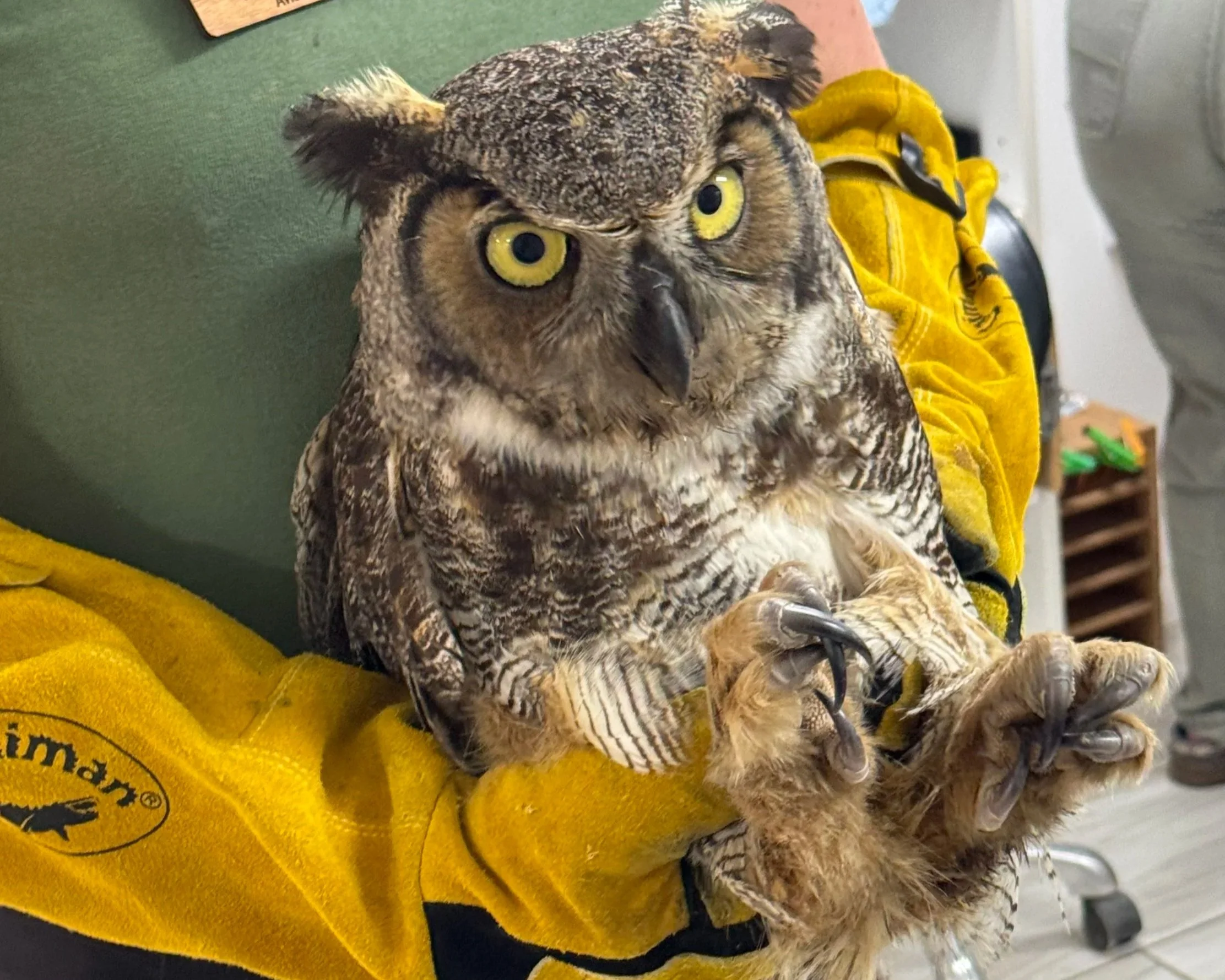
Every year, our rehabilitation team receives birds in one of the most distressing situations we encounter: tightly bound by the adhesive of a glue trap. Feet. Feathers. Sometimes an entire wing. The birds arrive terrified, exhausted, and in many cases badly injured — and that's only if someone noticed them in time.
Glue traps are designed to catch mice and rats. But they don't discriminate. They are a serious, often overlooked hazard to several species — including songbirds like wrens and sparrows, which forage on the ground, and raptors like hawks and owls hunting for a seemingly easy meal — in the spaces where these traps are commonly placed: garages, barns, basements, garden sheds, and near foundations.
And glue traps aren't the only danger. The poisons used to kill rodents — called rodenticides — pose a serious and often invisible threat to the birds that share our landscapes. Understanding both hazards is the first step toward protecting the wildlife around us.
When a bird lands on or brushes against a glue trap, the adhesive grabs instantly — and the bird's natural instinct to pull free only makes things worse. Struggling drives feathers, toes, and leg scales deeper into the glue.
By the time a bird reaches us, we're often dealing with:
Feathers pulled from the follicle, which often take several weeks to regrow
Fractured or dislocated limbs from the force of struggling
Skin tears, bruising, and open wounds where the adhesive has bonded to bare flesh
Severe hypothermia and dehydration from hours — or days — of exposure
Capture myopathy: the muscle breakdown that can follow severe stress and exertion
Removing a bird from a glue trap is a painstaking process that requires solvents, extreme patience, and expert hands. Even under the best conditions, some feather and skin damage is unavoidable. Many birds don't survive the experience. Those who do may face a lengthy rehabilitation — weeks or months — before they're strong enough to return to the wild.
Rodenticide poisoning is one of the most widespread — and least visible — threats to birds of prey and other wildlife. When a mouse or rat consumes rodent poison, the danger doesn't end there. It travels up the food chain.
Rodenticides work by accumulating in the fatty tissue of animals. A hawk that catches a poisoned mouse, or an owl that catches several over the course of a week, ingests that accumulated poison along with its meal. This is called secondary poisoning, and it affects a wide range of species: owls, hawks, eagles, foxes, coyotes, ravens, and even pet cats and dogs.
The most commonly used rodenticides are called anticoagulants. They work by halting the blood-clotting process, leading to fatal internal bleeding — a death that can take days and involves real suffering. There are two generations of these chemicals:
First-generation anticoagulants (FGARs), developed in the 1940s, include ingredients like warfarin and diphacinone. They require multiple feedings to be effective and have half-lives of 2 to 26 days in animal tissue.
Second-generation anticoagulants (SGARs) — including brodifacoum, bromadiolone, and difethialone — were developed in the 1970s when rodents began developing resistance to FGARs. SGARs are dramatically more potent, and they persist far longer: some have half-lives of up to 350 days. That means a bird of prey can be exposed to lethal levels of poison weeks or months after a rodent consumes it.
Another common type, bromethalin, is a neurotoxin that causes fluid to accumulate in the brain. It acts more quickly and breaks down faster than anticoagulants, but recent research suggests it can also bioaccumulate in tissue.
This is a recognized and growing crisis. On June 5, Maine's Board of Pesticides Control moved forward with a restriction on the sale and use of second-generation anticoagulant rodenticides (SGARs) — an important step toward protecting the wildlife that shares our landscape.
The data on rodenticide exposure in wildlife is alarming. A study in Massachusetts found that 100% of Great Horned Owls tested between 2006 and 2016 had at least one anticoagulant in their system. In Vermont and New Hampshire, 98% of 45 fishers tested were positive for at least one anticoagulant. Rehabilitation centers bear witness to this daily: in 2024, 86 of 148 birds of prey brought to Congress of the Birds in Rhode Island died or were euthanized due to rodenticide poisoning. The Massachusetts-based New England Wildlife Center sees 100 to 200 secondary rodenticide poisoning cases every year.
At Avian Haven, comprehensive rodenticide testing is cost-prohibitive, so we aren't able to definitively confirm exposure in the raptors we treat. What we can do is run bloodwork to evaluate how well a bird's blood is clotting — a key indicator of anticoagulant poisoning. Combined with a bird's clinical presentation, history, and the circumstances under which it was found, this gives our team a working picture. In many cases, we strongly suspect rodenticide involvement even when we can't confirm it with a toxicology panel.
It's worth noting that not all exposures are fatal. Sub-lethal poisoning — where an animal is sickened but doesn't die immediately — can cause prolonged suffering, impaired hunting ability, and increased vulnerability to other threats. A poisoned owl is a weakened owl, and a weakened owl is less able to hunt the very rodents we hoped to control.
We understand that mice and rats in the home are a genuine problem — one that households need practical solutions for. The good news is that effective alternatives exist that don't put birds or other wildlife at risk.
Snap Traps Old-fashioned snap traps, when placed correctly, kill quickly and humanely. Place them inside enclosed spaces where birds cannot reach — inside a cabinet, behind an appliance, or tucked into a corner. Check and reset them regularly.
Live Traps Live catch traps allow you to release rodents away from your home. Check them frequently — at least twice daily — to prevent captured animals from suffering from stress, exposure, or dehydration.
Exclusion and Prevention Sealing entry points is the single most effective long-term strategy. Steel wool, hardware cloth, and caulk can close the gaps that rodents use to enter. Eliminate attractants: store birdseed and pet food in sealed containers, and keep compost bins tightly covered.
Natural Predators Installing an owl nest box on your property is a long-term investment in natural rodent control — and a beautiful one. A single owl family can consume more than 1,000 rodents per year.
If you find a bird in a glue trap, time is of the essence. Here is what to do:
Do not pull the bird free — this causes severe injury. Keep the trap flat and stable.
Keep the bird calm and warm, Place the trap, with the bird on it, into a box lined with
soft cloth. Cover loosely.
Do not attempt to use oil or cooking spray to free the bird on your own
— removal requires expertise and specific materials to avoid further harm.
Call Avian Haven immediately at (207) 382-6761. We can connect you with a
volunteer transporter in your area, or walk you through next steps.
The birds arriving at Avian Haven with glue-trap injuries and rodenticide poisoning have one thing in common: they didn't have to be here. These are preventable harms — and awareness is the most powerful tool we have.
We rehabilitate approximately 3,000 birds every year across more than 150 species at our facility in Freedom, Maine. None of that work is possible without the generosity of people who care about what happens to Maine's wild birds.
If you believe every bird deserves a second chance, please consider making a gift today. Your support funds the hands-on care, the medical supplies, and the staff expertise that give injured birds a path back to the wild.
Thank you to Maine Audubon for this article which included a lot of the research we used here.
