
What It Really Takes to Bring a Bird Back to the Wild
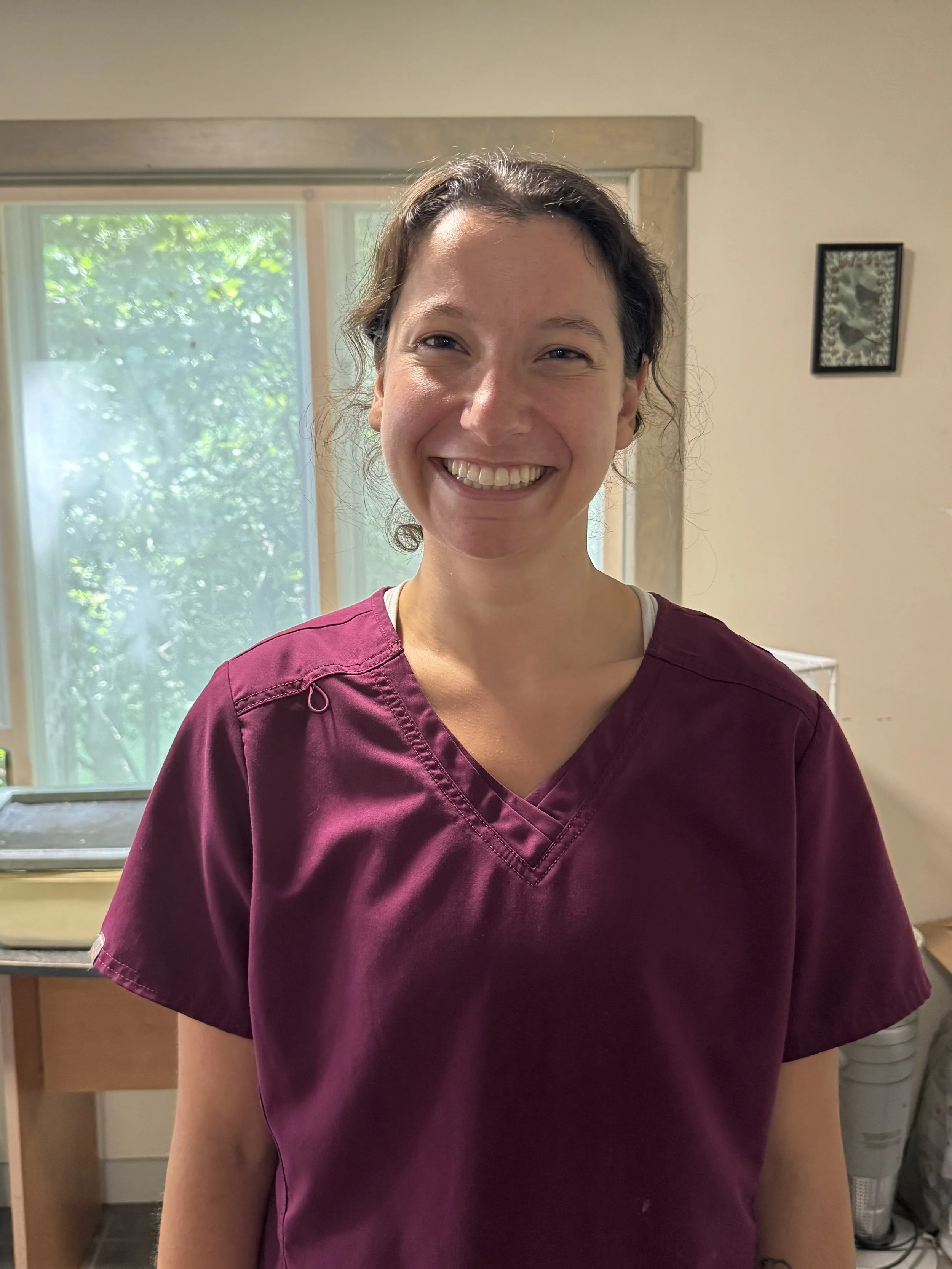
Every year, our rehab team makes thousands of decisions most people never see: whether a bird will be able to heal from a presenting issue and thrive in the wild, when it's ready for release, and where exactly to let it go. We asked readers what they wanted to know about that process, so I sat down with Senior Rehab Tech Athena Furr to walk through it.
Athena didn't set out to become a rehabber. As a student at Unity College, just fifteen minutes from our clinic, she needed an internship to fulfill a credit and landed at Avian Haven almost by chance — by her own admission, not even much of a bird person at the time. "It's a very unique setting," she says. "I just kind of fell into it, and I fell in love with it, and I fell in love with birds." That internship became a job, and today she's one of our Senior Rehab Techs.
What People Don't See
When a bird arrives at Avian Haven, it tends to be one that really isn’t doing well. “The birds that arrive here are often in dire condition,” said Athena.
Rehabbers are constantly toggling between the benefits of medical intervention with the risks of captivity. Wild animals aren't meant to be in captivity, and yet captivity, for a while, is exactly what many of them need to survive. "It's finding the middle ground," Athena says simply. "And it's hard."
The First Hour
Every bird that comes through our doors goes through the same careful process: decompression time when possible, then a beak-to-tail physical exam, joint by joint, in the same order every time. "So that we don't skip anything or miss anything," she says.
This is also where the public plays an unexpectedly critical role. The details a finder or transporter can offer — where exactly the bird was found, what it was doing, what nearby hazards might exist — often become the key clue in an otherwise silent diagnosis. "The more information you can give," Athena says, "the more it will help you really locate what the problem is."
From there, the team makes fast, layered decisions: Does this bird need X-rays? Fluids? Is it dangerously thin, and if so, how carefully do we need to reintroduce food so its body can actually process it? All of this, for any one of the more than 400 bird species found in Maine — from a loon that must stay in water, to a baby hummingbird so small it needs feeding every fifteen minutes.
The Hardest Calls
Not every bird that survives its injuries can return to the wild — and knowing the difference is one of the most difficult parts of the job.
Some answers are species-specific. An owl can often be released with just one working eye if it has had a season of experience hunting, because it relies mainly on hearing to hunt. But for most birds, lasting vision loss means an end to any real chance at survival — no ability to find food, migrate, or avoid predators. Sometimes the line isn't even about survival in the short term. Athena recalls a turkey with a dislocated jaw who could still eat just fine, but whose condition was clearly going to worsen over time.
This is where Avian Haven's consulting veterinarian, Dr. Avery Berkowitz, of Maine Wildlife Rehabilitation, becomes invaluable. Veterinary expertise specialized to wildlife is rare, and it opens doors the rehab team can't open alone — better knowledge of medications, surgery, and simply another experienced perspective in the room. "Not every approach is going to work for one bird that works for the next," Athena notes. "Having a lot of different people that know different things is super helpful."
How Long, and Where To
The timeline for recovery varies enormously by species. Nestling songbirds tend to stay the longest — often around two months — because in addition to healing, they have to grow, fledge, and learn to fly entirely from the ground up. The team starts flight testing as early as it safely can. "They've already had to grow up at Avian Haven," Athena says. "We want them to get back into the wild as fast as possible." For an adult bird with something like head trauma and no other complications, the team typically aims for one month or less. However, it’s important to look at the individual bird rather than shoot for a deadline.
Deciding where to release a bird is its own careful calculation. The ideal for most species is always to return a bird to exactly where it was found — but exceptions are common. An eagle recovering from a territorial dispute can't go back to the same spot, or it risks a repeat confrontation. A bird recovering from rodenticide exposure is often released farther from where it was found, away from whatever exposed it in the first place.
Crows are a case all their own. Because crows recognize their own family members and voices across generations, it's essential that an adult rehabilitated crow return to its exact home territory. Release it elsewhere, and the local crows will treat it as a stranger and an intruder — a mistake that can turn violent. For flock-dependent species like cedar waxwings, the presence of the flock itself matters more than the exact address; if the flock has moved on, the bird is released wherever another flock is now.
Before any bird is cleared, it must meet a strict set of standards: clinical clearance, strong flight from the ground up, recognizing its own species and the ability to mate, can hunt and feed, good stamina and ability to avoid predators — plus requirements unique to each species. A loon must be able to dive and stay properly waterproofed. An owl must fly in complete silence, or its prey will simply hear it coming.
The Toughest Patients
Ask Athena which species are hardest to treat, and pelagic birds top her list — puffins, northern gannets, petrels, guillemots. These birds have very high metabolisms and are often already near collapse by the time they're found, sometimes requiring tube feeding every hour or two. They're also simply not built for proximity to people, and that exposure alone can bring on disease. "We try to get them in and out as fast as possible," she says, "because it's a lot of stress."
Bird-eating raptors present a different challenge. Species like peregrine falcons, Cooper's hawks, sharp-shinned hawks, and goshawks are built for high-speed, high-stakes hunting — and that same intensity makes them prone to injuring themselves in captivity. It's part of why our flight enclosures, which allow birds to fly in a full circle and chase moving food, matter so much. "We're trying to manage these things by doing what they would experience in the wild as much as we can," Athena explains, "while still giving them the treatment that they need."
No Textbook for This
Wildlife rehabilitation is still a young science, without the standardized protocols that exist in companion animal medicine. For Athena, that reality is both frustrating and energizing. "I would love to know exactly how to do everything," she admits. "But the reality is, you have five different answers usually because every patient, even if it's the same species, is very different." She's come to see that uncertainty as part of the work rather than an obstacle to it — a reason to keep learning, one bird at a time. Hard-won proof of that came early in her career: the first time she was called on to handle wound care alone on a badly injured great horned owl, she cleaned and dressed the wound herself — and later watched that same owl released back into the wild. "That was a total full circle," she says.
Why It Matters
"From the outside, rehab seems easy," Athena reflects. "The reality is night and day." It's demanding work, mentally and physically, sustained by nothing but genuine care for the animals. Some days bring loss. Others bring a bird, once broken, flying free again. "That's the only reason we do it," she says.
Every bird that comes through Avian Haven's doors — whether a nickel-sized baby hummingbird or a territorial eagle — depends on the kind of skill, judgment, and heart our rehab team brings every day. Your support gives our team the resources to give each of Maine's 400+ bird species the individualized care it takes to return them to the wild.
**We’d love to request that if you’ve had a good experience with us, that you please write a positive Google review in support. We are also always open to constructive feedback as our goal is to constantly be improving. Thank you!
