
An Update on the Thick-Billed Murre
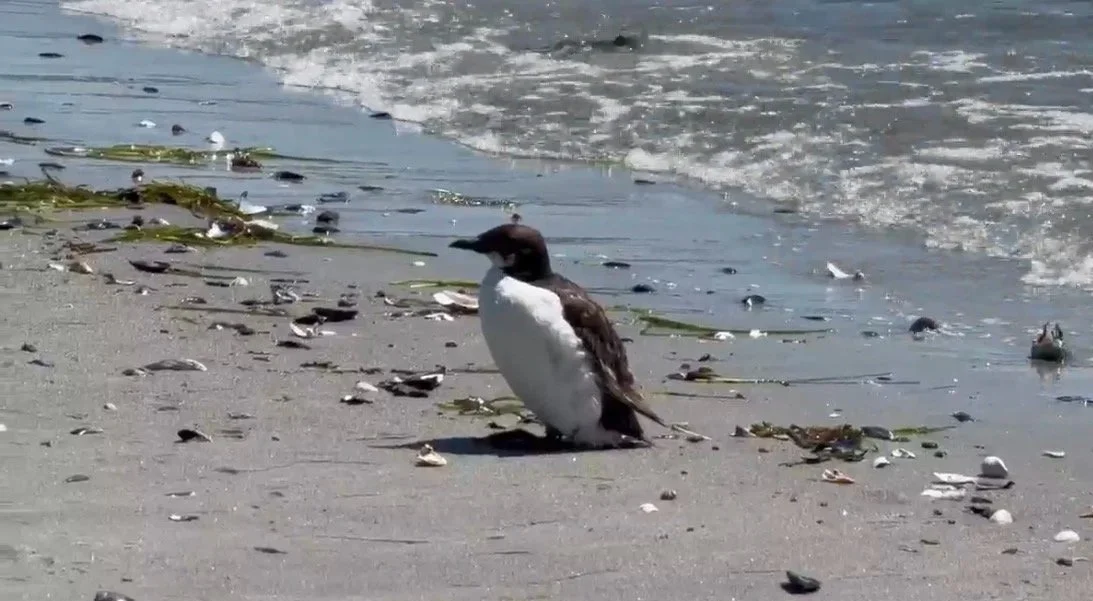
We’ve been getting a lot of calls about a Thick-Billed Murre that has been sitting on the beach in Scarborough, and in concert with a group of professionals who have been observing it, we have determined that it doesn’t need to be brought into Avian Haven at this time because it doesn’t appear to be sick, injured, or orphaned. We asked Derek Lovitch, ornithologist, biologist and owner of Freeport Wild Bird Supply to share his observations with you all:
A Thick-billed Murre has been present in and around the mouth of the Scarborough River in Scarborough, Maine since at least July 18th, often observed sitting on Western Beach, especially in early mornings and at high tides. Out of season and out of place, it is obviously garnering significant attention from birders, nature enthusiasts, and concerned citizens. Many birders have never seen a Thick-billed Murre in Maine, at least not in summer, definitely not while wearing shorts and sandals, and probably not in this plumage, yielding a potentially once in a birding-lifetime opportunity.
In winter, Thick-billed Murres occur regularly in Maine waters, but often are only seen nearshore after strong storms or in periods of food shortages. Many of these birds are not well. A Thick-billed Murre on the beach in winter is not healthy, and actions may be warranted to bring such individuals into rehab facilities.
As one can see from the amount of photographs of onlookers in bathing suits, it is not winter. However, there is a Thick-billed Murre standing on the beach, which is rather incredible, as they breed no closer than Newfoundland, while non-breeders are usually found well offshore in open waters. Why it is here is a mystery.
This bird was born last year and is in its “second year” or “first summer plumage,” which is readily distinguished by its head and face pattern, including “throat feathers completely whiter some with dark tips (Pyle 2008)”. Why this individual has chosen to spend its summer inshore in Maine is unknown, and its very occurrence is so extraordinary as to immediately cause concern.
But extensive observation by myself and other qualified observers (several of whom have experience at seabird colonies; I myself spent three summers surrounded by tens of thousands of Thick-billed Murres in Alaska) do not believe the bird is showing any indication of serious health issues at this time.
It is regularly observed diving for food, and its time ashore is spent upright and preening extensively. I would expect an unwell bird to be lethargic, to not be spending much of the day diving, and to be sitting on the beach, not standing alertly and preening. If the bird was in as dire shape as some have suggested, it would not still be alive a month later.
Therefore, I see nothing that indicates any serious health concerns at this time, and therefore no reason to suggest that this individual needs our direct active assistance.
The reasons for genuine, good-hearted concern is its presence, but also a misinterpretation of its behavior. 1. Murres cannot take off from flat land; they need to jump down off a cliff or large rock or have a running start in the water. 2. Even if it wanted to, it can’t fly right now due to its wing molt. And a molting bird is usually a healthy bird, as birds usually suspend molt in times of food stress. 3. The molt pattern makes the bird, especially when it flaps, look, well, not good.
“The molt strategies of alcids are not well known (overall), in large part because of the difficulty in following birds at sea over their first years of life…(however)…many species become flightless during their prebasic molt (Howell, 2010), and this is the case in both Common and Thick-billed Murres.”
According to Gaston and Jones (1998) murres molt “contour and flight feathers simultaneously, with primaries all being shed within a few days,” rendering them flightless for 42-90 days (based on a study in captivity)” and “were probably flightless for an average period of 4-6 weeks.”
The Pine Point area individual is a “second year” or “first summer” bird based on plumage (adult plumage is obtained in 1-2 years in the alcidae). Part of the misunderstanding here is that murres in their first summer have a different molt cycle from adults. While adult Thick-billed Murres undergo their prebasic molt in September and October well offshore, second-year (SY) birds complete their molt over the course of the summer (Gaston and Jones, 1998). Additionally, “primary feathers on second year birds visiting the breeding colony in August usually show much greater wear than those of breeders, suggesting more time has elapsed since replacement (Gaston and Jones, 1998).”
Interestingly, Howell (2010) also states that the alcids, including the murres, that do become flightless have a prebasic wing molt that “may have an underlying sequence in which the middle primaries molt before the inner and outer primaries.” Howell postulates that “the paddle-shaped surface area produced by regrowth in this sequence is a more efficient wing shape for underwater propulsion than would result from regrowth in a standard sequential order.”
In other words, the wings look like a mess right now, but based on its age, they should be! The molt pattern seems consistent with a healthy bird of its age, and its constant preening is expected in a bird undergoing molt.
But why is it sitting on the beach so much? This is a good question, but the overarching answer is 1. It feels safer doing this, and 2. It takes less energy to waddle onto the beach than hop onto a rock while flightless. While there is a significant risk of predation, especially from Bald Eagles, dogs, and foxes while on land, there are also predators in the water, including seals and sharks. The presence of large numbers of Great White Sharks in the immediate area of late could be enough to make the bird feel more comfortable loafing ashore than in the water, but also it may be more efficient to preen on dry land.
I am surprised it has not been predated by an eagle yet, but as observed when people get too close (including a reported attempt to capture it), the bird gets into the water and swims away. Another great sign of health, albeit a healthy bird with some really uglylooking wings.
Therefore, it is our personal and professional opinion that the bird should be left alone and simply given space. Regular monitoring of the bird, including signs of lethargy (sitting on its belly and sleeping) or a lack of progression in molt would be reasons for concern at this time. However, the bird has developed less fear of humans in the past month, deeming their threat less than wasting energy or facing predators in the water. Could the presence of humans on the beach even be deterring predators, such as eagles and foxes? Hard to know what the bird is thinking, but as long as it is making decisions mostly in line with its condition at this season, I believe only monitoring is required at this time. Should the accurate interpretation of its health condition change, this recommendation will be revisited immediately.
Sincerely,
Derek Lovitch
Freeport Wild Bird Supply
References:
Gaston, Anthony J and Jones, Ian L. 1998. The Auks. Oxford University Press: Oxford, New York, Tokyo.
Howell, Steve N.G. 2010. Molt in North American Birds. Houghton Mifflin Harcourt: Boston and New York.
Pyle, Peter. 2008. Identification Guide to North American Birds Part II Anatidae to Alcidae. Slate Creek Press: Point Reyes Station, California.
