
Do your part to protect ground nesting birds
Ground-nesting season is here. Here's what that means for the birds in your yard — and what you can do to protect them.
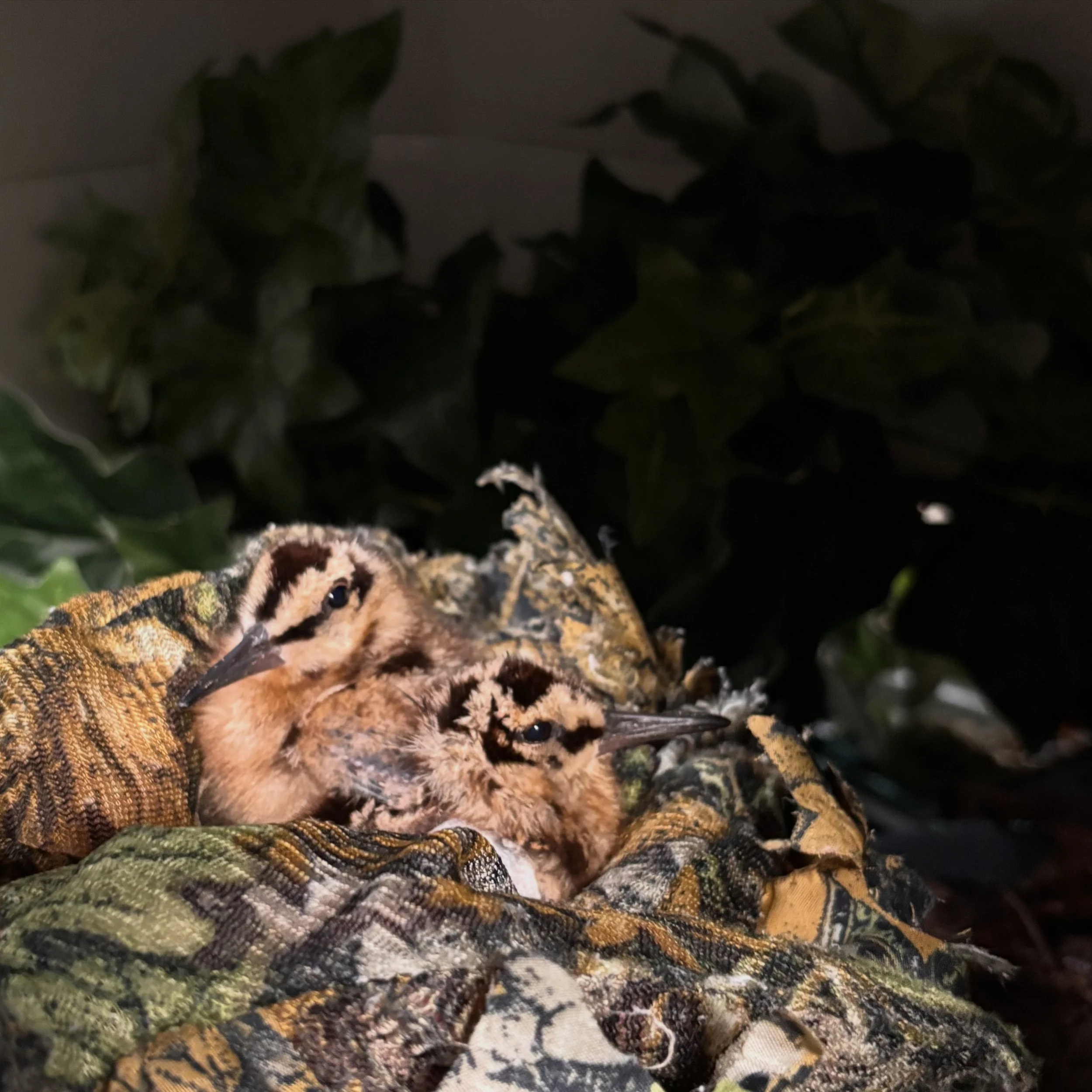
Two Chicks and Two Injured Adults: A Week at Avian Haven
This week, two baby American Woodcocks arrived at our facility as orphans. Shortly before that, we admitted an adult woodcock who had been attacked by a cat in someone's backyard. Yet another woodcock came in last weekend.
The babies came to us helpless — tiny, downy, and entirely dependent on feeding and warmth. The adult required immediate wound treatment. What unites their stories is timing: they arrived during one of the most critical and dangerous periods of the year for ground-nesting birds in Maine.
The American Woodcock: Maine's Most Surprising Bird
If you've never seen an American Woodcock up close, you're not alone — they are masters of disguise. Their mottled brown-and-buff plumage blends so perfectly with leaf litter that they're nearly impossible to spot even when you're standing a few feet away.
What they lack in visibility, they make up for in personality. Woodcocks are shorebirds that abandoned the shore — they live in young forests, brushy fields, and the wet edges of meadows across Maine. In spring, males perform one of the most spectacular courtship displays in the bird world: a series of nasal "peent" calls at dusk, followed by a spiraling, twittering flight hundreds of feet into the air before tumbling back to earth.
But for all their charm, woodcocks are extraordinarily vulnerable during nesting season because:
Nests are on the ground. A woodcock nest is nothing more than a shallow scrape in leaves, often in the middle of a yard, garden edge, or brushy patch — not deep in the forest as many people assume.
Females sit tight. A nesting woodcock will not flush easily. She relies entirely on her camouflage, which means she may hold her position even as a predator or lawn mower approaches.
Chicks are precocial but tiny. Baby woodcocks leave the nest within hours of hatching and follow their mother on foot. They are mobile, but small and extremely vulnerable to predation.
Cat bites are nearly always fatal without treatment. Even a single bite or scratch introduces bacteria that can kill a bird within 48 hours if it doesn't receive veterinary care.
Other Ground-Nesting Birds to Watch For This Spring
Woodcocks aren't alone. Across Maine, a number of beloved species nest directly on the ground — in your yard, at the edges of fields, along roadsides, and in the woods behind your house. Nesting season runs roughly from late April through July for most of these species.
Ovenbird Named for its domed, oven-shaped nest hidden in forest leaf litter, the Ovenbird is one of Maine's most common woodland warblers. Its loud "teacher-teacher-teacher" call is a hallmark of summer mornings in the Maine woods. Because the nest is on the forest floor and the entrance is small and concealed, it's easy to step on without realizing it — or for a dog to find by scent.
Whip-poor-will Whip-poor-wills lay their eggs directly on the forest floor with no nest material at all — just bare leaves. They time their egg-laying to the lunar cycle, which makes them one of the more remarkable nesters in North America. Their populations have declined significantly in recent decades, making every successful nest critical. If you hear their distinctive call near your property at night, give that area a wide berth.
Killdeer Killdeer are among the most familiar ground-nesters because they often choose gravel driveways, parking lots, rooftops, and open lawns — places that feel entirely inhospitable to us but mimic the open, rocky habitat they evolved to use. Their famous "broken wing" distraction display, where they drag a wing along the ground to lead predators away from the nest, is a sign that eggs or chicks are very close by. If you see this behavior, back away slowly and give the bird space.
Dark-eyed Junco Juncos nest on or very near the ground, often on sloped terrain, under overhanging vegetation, or at the base of a stump or log. They're one of the most common birds at Maine feeders in winter — and one of the species most at risk from cats in spring and early summer, when they're nesting close to the homes where cats roam.
Ruffed Grouse Ruffed Grouse nest on the ground at the base of trees, stumps, or brush piles, often in mixed or deciduous woodland. The female incubates a clutch of up to a dozen eggs entirely on her own, sitting so still and relying so completely on her camouflage that she can be nearly invisible even to experienced eyes. Chicks are up to the ground within hours of hatching and are at serious risk from dogs, foxes, and outdoor cats in the days before they can fly.
Hermit Thrush Maine's only thrush to nest consistently on the ground, the Hermit Thrush tucks its nest into the base of shrubs or low vegetation, often in damp woodland edges and coniferous forests. It's a bird many Mainers know by sound — its flute-like, spiraling song is one of the most beautiful in the northern forest. Ground-level nesting makes eggs and chicks vulnerable to the same threats as other species on this list, including predation by roaming cats and disturbance from off-leash dogs.
Wild Turkey Wild Turkeys nest in a simple scrape on the ground, often at the base of a tree or tucked against a log or boulder. Hens can lay up to 14 eggs and incubate them alone for about a month. Though turkeys are large and familiar, their nests are surprisingly easy to miss in leaf litter and underbrush. Poults — newly hatched turkey chicks — are mobile quickly but remain vulnerable on the ground for the first two weeks of life before they can roost in trees.
What You Can Do
The good news is that protecting ground-nesting birds doesn't require much. A few simple habits during nesting season — roughly late April through July — can make a real difference.
Keep cats indoors. This is the single most effective action a cat owner can take. Studies estimate that outdoor cats kill between 1.3 and 4 billion birds in the United States every year. Ground-nesting birds, whose chicks can't fly to safety, are among the most vulnerable. Even a cat that is well-fed and doesn't appear to be hunting will follow instinct. If your cat goes outdoors, consider a catio, leash walking, or keeping them inside from dusk through mid-morning, when ground-nesting birds are most active.
Watch where you walk and mow. Before mowing your lawn or walking through brushy areas, scan the ground. Nesting birds are easy to miss. If you find a nest while mowing, stop and mow around it, leaving a buffer of a few feet. The nesting period for most species is only a few weeks.
Keep dogs leashed in areas with ground-nesting birds. Even a gentle, well-trained dog can destroy a nest or flush a sitting bird. If you're walking near fields, forest edges, or brushy areas during nesting season, keep your dog on a leash.
If you find an injured bird or abandoned nest, call us. We are available 365 days a year, 9am–5pm, at (207) 382-6761. Please do not attempt to care for an injured or orphaned bird at home — wild birds have specific nutritional and environmental needs that are difficult to meet without training and equipment, and well-intentioned care can do more harm than good.
